Visa rules change all the time. Stay legal by checking requirements for Asia's Travel and Retirement Visas. Updated July 2026.
How Does Traditional Indian Yoga Differ from Your Western Studio Class?
Uncover the real difference between traditional Indian Yoga and Western studio classes. It’s more than just poses; it’s about philosophy, the 8 Limbs, and the ultimate goal of liberation (Samadhi).
INDIAFITNESS AND EXERCISE
1/14/20263 min read
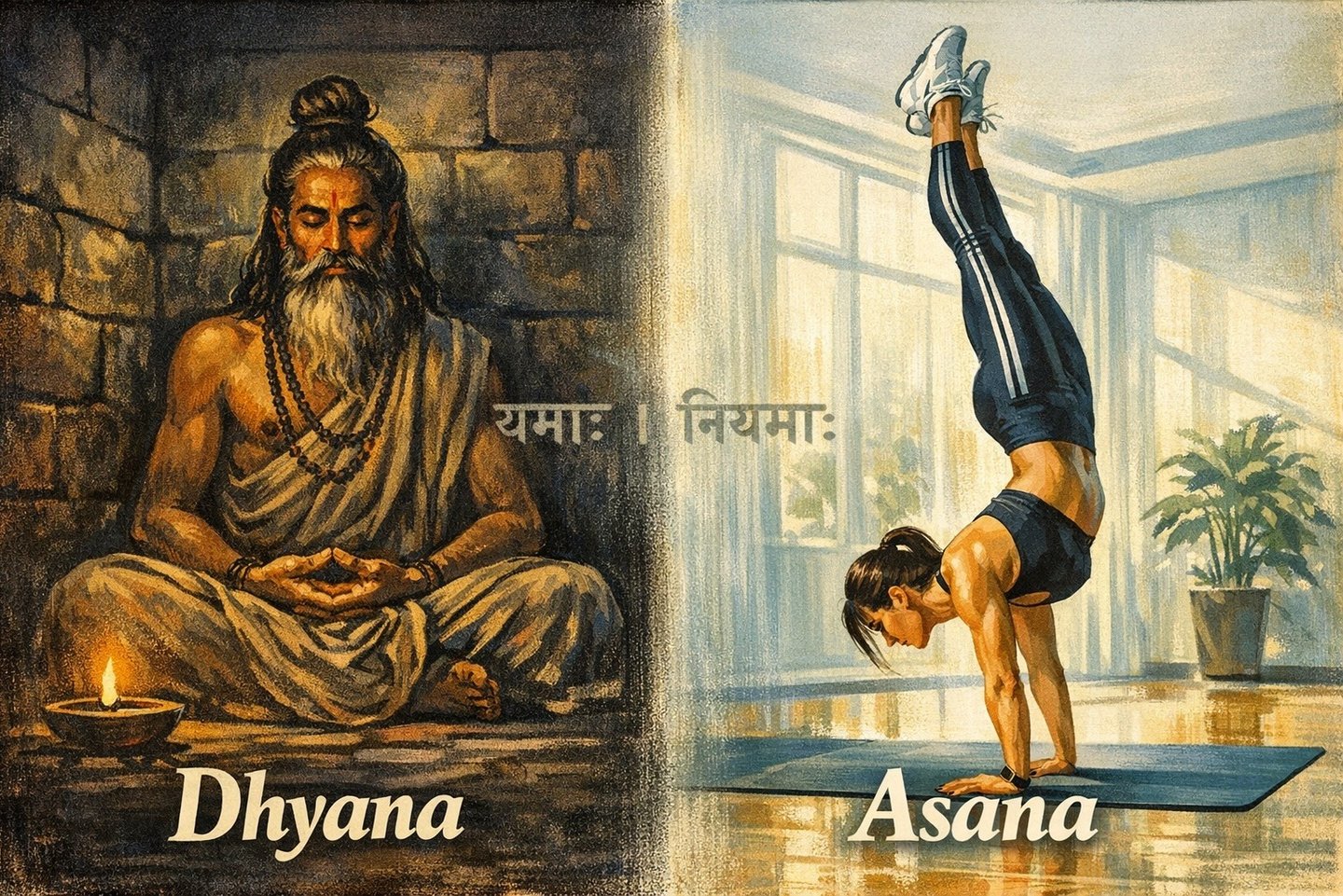
You’ve got your Lululemon gear, your $15 coconut water, and a class lineup that includes Hot Vinyasa, Power Sculpt, and Yin Flow. You’re doing yoga. It feels great, you’re strong, and you’re flexible.
But if you stepped off that polished studio floor and into a traditional ashram (आश्रम) in Rishikesh, you might feel like you’d landed on a different planet.
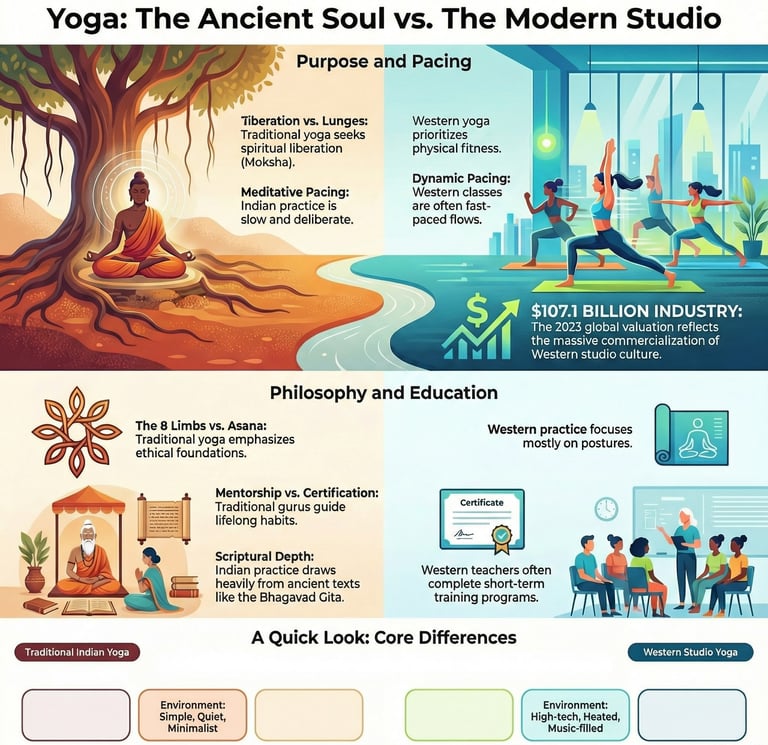
The truth is, the billion-dollar Western yoga industry—valued at approximately $107.1 billion globally as of 2023 (Source: Worldpay, 2024)—has beautifully commercialized the body of the practice, but often left its soul behind.
The difference between a 5,000-year-old traditional practice and your 60-minute studio flow isn't just about the temperature of the room—it's about the goal.
1. The Purpose: Liberation vs. Lunges
In India, Yoga (योग) is fundamentally a philosophical system for self-realization or moksha (liberation). It is not a form of exercise, but a pathway to still the fluctuations of the mind (Chitta Vritti Nirodha), as described in the ancient Yoga Sutras of Patanjali.
Traditional Indian Yoga
Primary Goal: Spiritual liberation (Samadhi), self-awareness, inner transformation.
Pacing: Slow, deliberate, meditative. Long holds on poses.
Environment: Simple, minimalistic, quiet. Emphasis on natural light or silence.
Western Studio Class
Primary Goal: Physical fitness, flexibility, stress relief, toning.
Pacing: Fast-paced, dynamic, flow-focused (Vinyasa).
Environment: High-tech, often heated, modern décor, frequently set to music.
2. The Eight Limbs: Not Just Asana
This is the biggest difference that gets lost in translation. In modern Western yoga, the word "yoga" has become synonymous with Asana (physical postures). However, Asana is only one of the eight limbs outlined in Patanjali’s classical Ashtanga Yoga.
A traditional Yogi must first master the first two limbs—the Yamas (ethical restraints like non-violence, Ahimsa) and Niyamas (personal observances like contentment, Santosha). These are the ethical foundation.
I once spent a week studying in an ashram where the first three days involved zero physical stretching. Instead, we discussed how to apply Satya (truthfulness) to our daily communications and how to practice Ishvarapranidhana (surrender to a higher power). The physical poses only came after we had grounded ourselves in the moral and philosophical context.
3. The Teacher and The Text
In the West, teachers often complete intensive training programs in just a few weeks or months.6 This is efficient, but it often lacks the Guru-Shishya (Teacher-Disciple) relationship foundational to Indian practice.
The Guru: Traditional training is a long-term mentorship rooted in respect and service, where the teacher focuses on the student's entire lifestyle—including their diet (sattvic food) and behavior—not just their alignment.
The Text: Traditional practice draws directly from Sanskrit scriptures like the Bhagavad Gita and the Upanishads. While many Western teachers reference these, the depth of continuous scriptural study often takes a backseat to learning new flow sequences.
The Honest Conclusion: An Adaptation, Not a Dilution
Does this mean your studio yoga isn't "real" yoga? Absolutely not. Yoga has always adapted.10 The fact that an ancient Indian philosophical practice has brought millions of people stress relief, better sleep, and reduced anxiety speaks to its universal power.
The modern style is an essential and valuable adaptation for the contemporary world, giving us a powerful tool to manage our fast-paced lives. But by understanding the difference—that Yoga is fundamentally about the mind's journey to union, not just the body’s journey to the splits—you can deepen your practice, whether you're in a heated studio in New York or on a quiet mat in Kerala.
➡️ Call to Action
Are you looking to integrate more philosophy into your practice? Start by dedicating 10 minutes to seated meditation (Dhyana) before your next class. Share your experience in the comments!
How Seniors can practise Chair Yoga.
How Yoga and Retirement an go hand in hand.
The best food for women over 40.
Disclaimer: This article is for informational purposes only and does not constitute professional advice.

Address
Blk 8 Cantonment Close
SIngapore