Visa rules change all the time. Stay legal by checking requirements for Asia's Travel and Retirement Visas. Updated July 2026.
Is Asia Really Cashless? A Senior's Traveller Look Behind the Digital Payment Hype
Is Asia truly cashless? We cut through the hype to reveal the truth. Compare China’s dominance with South Korea's card culture, Thailand's QR codes, and Japan's cash preference in 2025.
TRAVEL
1/12/20264 min read
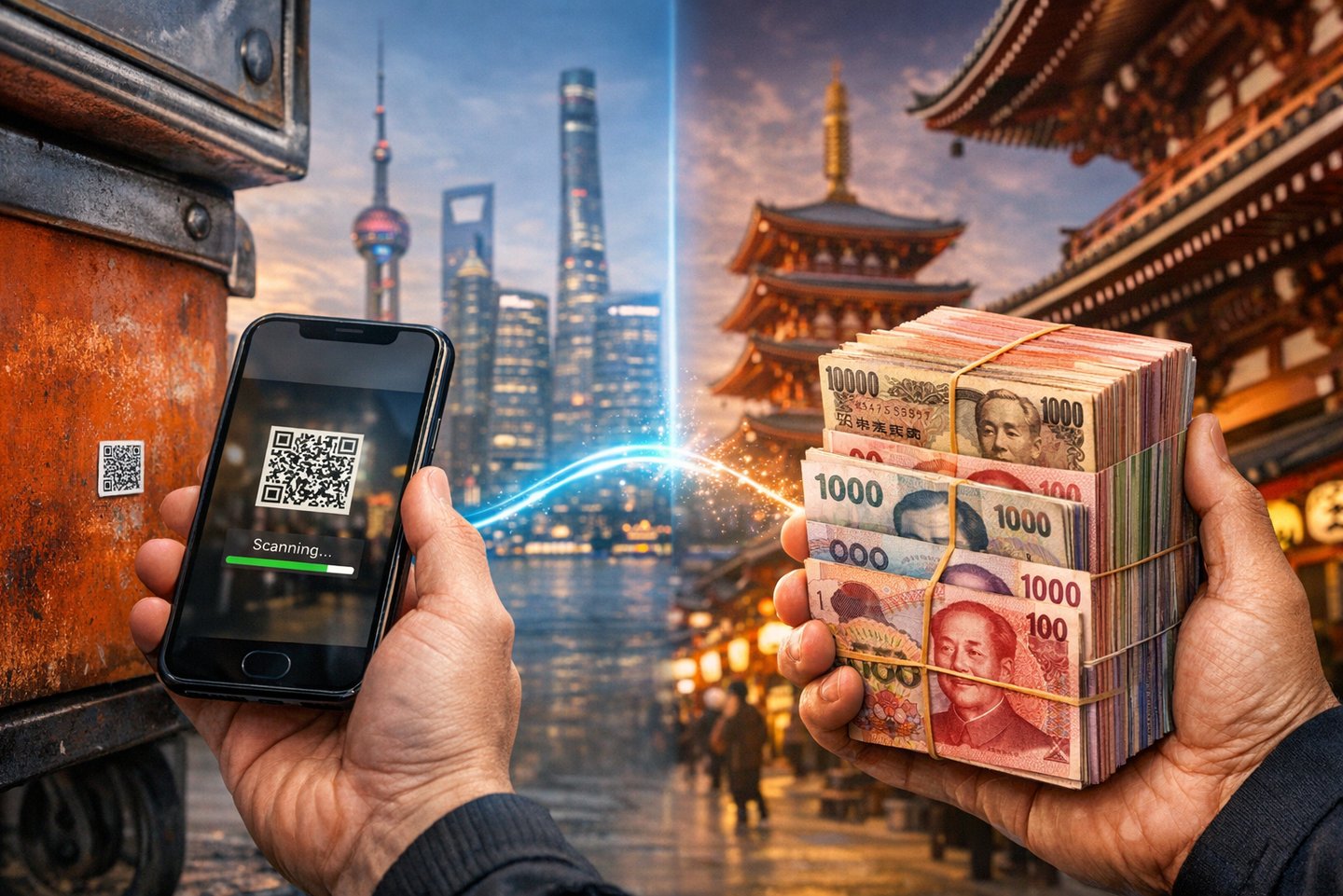
Have you ever landed in a major Asian city like Shanghai or Singapore, watched a street vendor accept a payment with a quick QR code scan, and thought, "Wow, cash is officially dead here?"
It’s easy to get that impression. We hear the headlines: China is basically cashless. India’s UPI is an unstoppable force. The entire region is a digital payment laboratory. It paints a picture of a single, unified, tap-and-go continent where physical money is an antique novelty.
But here’s the truth: Asia is not cashless—it’s less-cash, and the difference is huge. The continent is a complex, fascinating mosaic where hyper-digital economies exist side-by-side with cash-heavy cultures. Step outside the major tech hubs, or even into a traditional market, and you’ll quickly realize that the physical wallet is far from extinct.
The Digital Giants: China and India Lead the Charge (The 支付宝 & UPI Story)
There’s no denying the tectonic shift in certain markets. China and India rewrote the rules for digital payments by skipping the credit card phase and jumping straight to mobile wallets. This allowed for massive, instantaneous adoption.
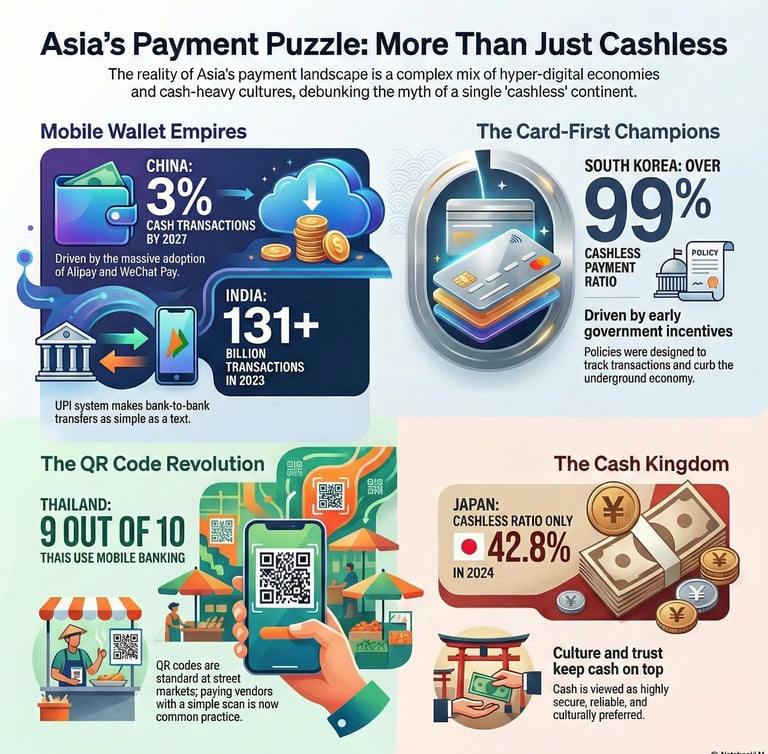
China’s Dominance: Digital payment penetration in China is phenomenal. By 2027, the share of cash transactions is forecasted to drop to a mere 3%, down from 47% in 2019, according to a 2025 report from Worldpay. This is thanks to the ubiquitous presence of apps like Alipay (支付宝, Zhīfùbǎo) and WeChat Pay (微信支付, Wēixìn Zhīfù).
India’s UPI Explosion: India's Unified Payments Interface (UPI) has been a game-changer for financial inclusion. The system processed over 131 billion transactions in the fiscal year 2023 alone (PwC India, 2024), making real-time, bank-to-bank transfers as simple as sending a text message.
These markets, driven by sheer population size and government-backed initiatives, have overwhelmingly embraced the digital-first life.
The Card and QR Crusaders: South Korea and Taiwan
Not all cashless revolutions rely on mobile wallets alone. In South Korea and Taiwan, the shift away from cash happened earlier, driven by different factors:
South Korea (한국): South Korea is often cited as the most cashless major economy globally, but its story is one of credit card dominance. Driven by early government incentives to track transactions and curb the underground economy, card usage soared. Nearly every small business, from the subway to the smallest street vendor, accepts cards. While mobile apps like Naver Pay and Kakao Pay are popular, cash has been marginalized for two decades. The cashless payment ratio in South Korea exceeds 99% (Korea Institute of Finance, 2024).
Taiwan (臺灣): Taiwan follows a similar path but with a more recent shift. Government mandates and the popularity of digital platforms like JkoPay are pushing the needle. While you might still need cash for night markets, major retailers and Taipei’s public transport are heavily integrated into card and digital payment ecosystems, creating a highly efficient, though slightly less mobile-wallet-centric, payment landscape.
The Southeast Asian Patchwork: Thailand and Malaysia
This is where the term 'patchwork' truly applies. In Southeast Asia, digital payments are booming, often driven by super-apps that combine payments, ride-hailing, and delivery services.
Thailand (ประเทศไทย): Thailand is a QR code powerhouse. The national PromptPay system, which enables instant transfers between bank accounts using a QR code, has transformed the market. Paying a vendor at the Chatuchak Weekend Market using a simple QR scan is now standard practice. However, cash remains necessary for very small purchases or in remote provinces. A 2024 survey showed that 9 out of 10 Thais use mobile banking, indicating a massive shift in habit (Bank of Thailand data, 2024).
Malaysia: Malaysia is rapidly moving towards a digital economy, bolstered by apps like Touch ‘n Go eWallet and Boost. The government has actively pushed initiatives to encourage e-wallet use, especially after the pandemic. While major shopping malls are almost entirely digital, the transition in small, family-run shops and neighborhood eateries (like the traditional kopitiams) is still underway, making cash an essential backup.
The Cash Stronghold: Why Physical Money Still Reigns
Finally, let’s travel to the other side of the digital coin: Japan.
My friend, who travels to Japan frequently for business, once joked, "I feel guilty every time I pull out my debit card." The experience of paying for a small snack in Tokyo often involves polite apologies for making the clerk handle a card machine, let alone a QR code.
Japan, a global leader in technology, is ironically one of the most cash-dependent major economies. Why?
High Trust: Cash is viewed as highly secure and reliable—there's virtually no concern about counterfeits or street crime.
Cultural Preference: While digital is growing (Japan aims for a 40% cashless ratio by 2025), credit cards, not mobile wallets, are the dominant non-cash method. The cashless payment ratio in Japan was only 42.8% in 2024, far behind South Korea (99%) and China (83.5%) (Ministry of Economy, Trade and Industry, 2024).
The Digital Divide: Even within digital-dominant countries, cash is still crucial for financial inclusion for those who are unbanked or elderly.
The Surprising Truth: It's About Convenience, Not Exclusivity
The "surprising truth" is that Asia is a patchwork. The goal for most Asian governments and fintech companies isn't to eliminate cash entirely, but to ensure that digital options are so convenient and accessible that they become the default.
In the end, whether you’re scanning a QR Code for street food in Bangkok or withdrawing yen (円) from an ATM in Kyoto, the future of Asian payments is about having seamless options. It’s not about choosing one over the other; it’s about having a choice for every scenario—be it high-tech or low-tech
➡️ Call to Action
How are you paying in Asia? Share your personal experience with mobile wallets versus cash in South Korea or Thailand in the comments below!
Disclaimer: This article is for informational purposes only and does not constitute professional advice.

Address
Blk 8 Cantonment Close
SIngapore