Visa rules change all the time. Stay legal by checking requirements for Asia's Travel and Retirement Visas. Updated July 2026.
Scientists Just Proved What We Suspected: Travel Is Anti-Aging Medicine
New research from Edith Cowan University reveals how positive travel experiences boost immunity, metabolism, and stress recovery — and may genuinely slow the aging process. Here's what the science actually says, and why your next trip deserves a line in your health budget.
TRAVELUSEFUL MEDICAL KNOWLEDGE
5/17/20264 min read
The Study That Started the Conversation
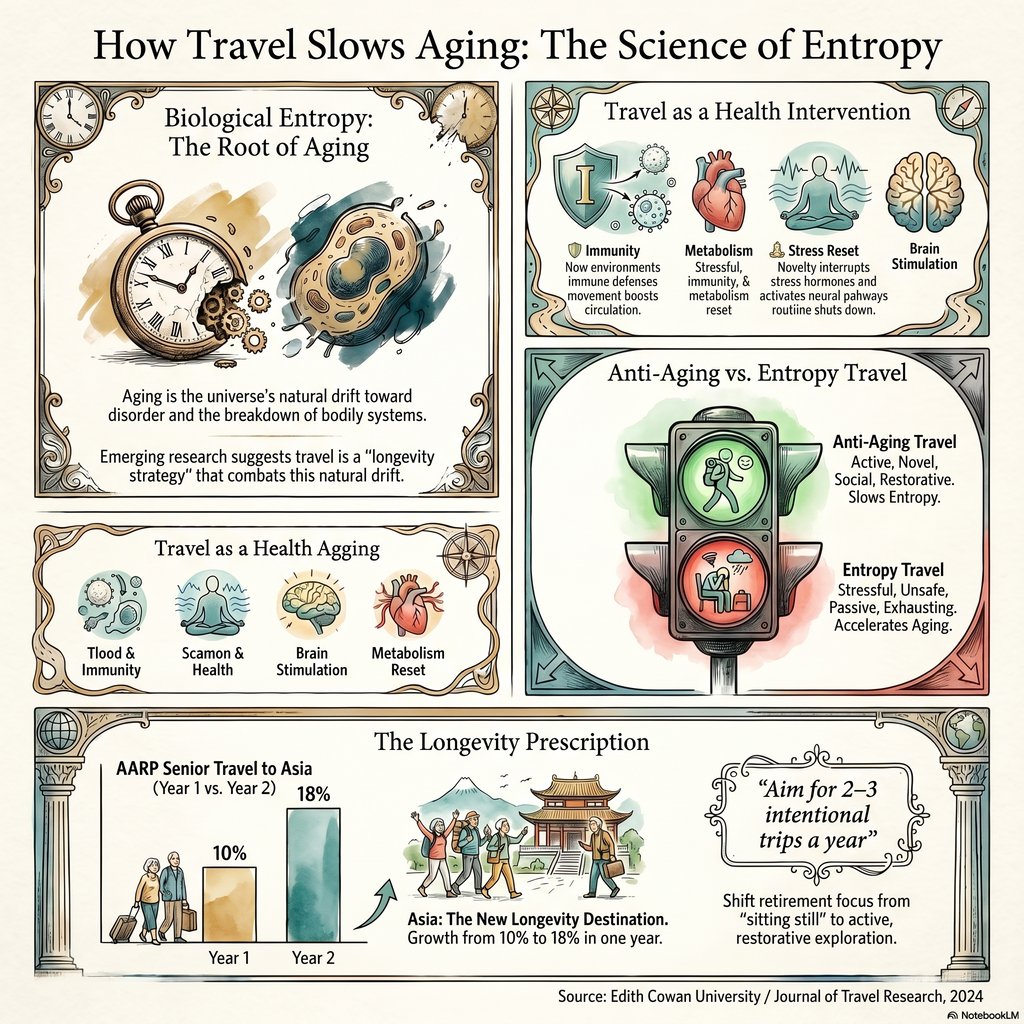
Researchers at Edith Cowan University in Australia applied the concept of entropy to human health and tourism. If entropy feels like a dusty physics term, here's the plain version: it's the universe's natural drift toward disorder. In your body, entropy is what aging looks like at a cellular level — the gradual breakdown of systems that keep you functioning, repaired, and resilient.
The researchers' proposal? Positive travel experiences may help slow that drift.
"Aging, as a process, is irreversible. While it can't be stopped, it can be slowed down," said Ms. Fangli Hu, the ECU PhD candidate who led the research.
The study frames tourism not as a frivolous expense or a reward you've earned — but as an active health intervention. One that combines novelty, physical movement, social connection, and genuine restoration in a package your body, it turns out, is wired to respond to.
What Actually Happens Inside You When You Travel Well
The study identified four biological systems that positive travel may support. These aren't vague wellness claims. They're the same systems any longevity researcher would point you towards.
Your immune system gets a workout. New environments introduce your body to unfamiliar stimuli — different air, different microbes, different sensory inputs. Your adaptive immune system responds by activating and recalibrating. Over time, this can build genuine resilience. Think of it less as exposure to germs and more as a calibration session for your body's defence infrastructure.
Your metabolism wakes up. Travel almost always involves more movement than your daily routine. Walking through a night market in Penang, climbing to a temple in Luang Prabang, cycling along a coastal path in Da Nang — none of it feels like exercise, but it is. The researchers noted that physical activity improves blood circulation, nutrient transport, and waste elimination. It supports the systems responsible for keeping your body repaired and running cleanly. (If you want to supercharge this further in daily life, our guide on running for seniors is one of the best starting points we know.)
Chronic stress finally gets interrupted. Low-level, persistent stress is one of the most corrosive forces on healthy aging. It suppresses immune function, disrupts sleep, and accelerates cellular wear. Travel — the right kind — breaks that loop. A genuinely unfamiliar environment gives your nervous system permission to shift. New sights, good food, and the simple absence of your usual pressures create the conditions your stress hormones need to reset.
Your brain gets the novelty it craves. Navigating an unfamiliar city, reading a different script, adapting to a new culture — these are forms of cognitive exercise that habitual routine simply cannot replicate. Novel environments light up neural pathways that gradually quiet down when life becomes predictable. For seniors, this kind of stimulation is one of the most meaningful tools for maintaining cognitive health.
The Part Nobody Talks About: Not All Travel Counts
Here's where the researchers are direct, and where it's worth paying attention.
Stressful, poorly planned, or unsafe travel doesn't just fail to help. It may actively accelerate the biological processes it's supposed to slow. The study was explicit: negative travel experiences push the body toward entropy, not away from it. COVID-19 was cited as an extreme example of how travel under the wrong conditions becomes a health threat rather than a health benefit.
This isn't an argument for staying home. It's an argument for travelling deliberately.
The travel most likely to support healthy aging combines four ingredients:
Novelty — somewhere genuinely new to you, even if it's nearby
Movement — walking, swimming, hiking; not exclusively horizontal tourism
Social connection — with locals, fellow travellers, or companions you actually like
Restoration — real rest and sensory pleasure, not an itinerary crammed with obligations
And of course, part of travelling well is eating well — something the best destinations in Asia make effortless. We've written about the joy of good food in retirement and how to approach it without compromising your health goals.
If You're Based in Asia, You're Already Sitting on a Goldmine
For readers in Singapore, Malaysia, Thailand, or anywhere in the region, this research should feel like a permission slip arriving in the post.
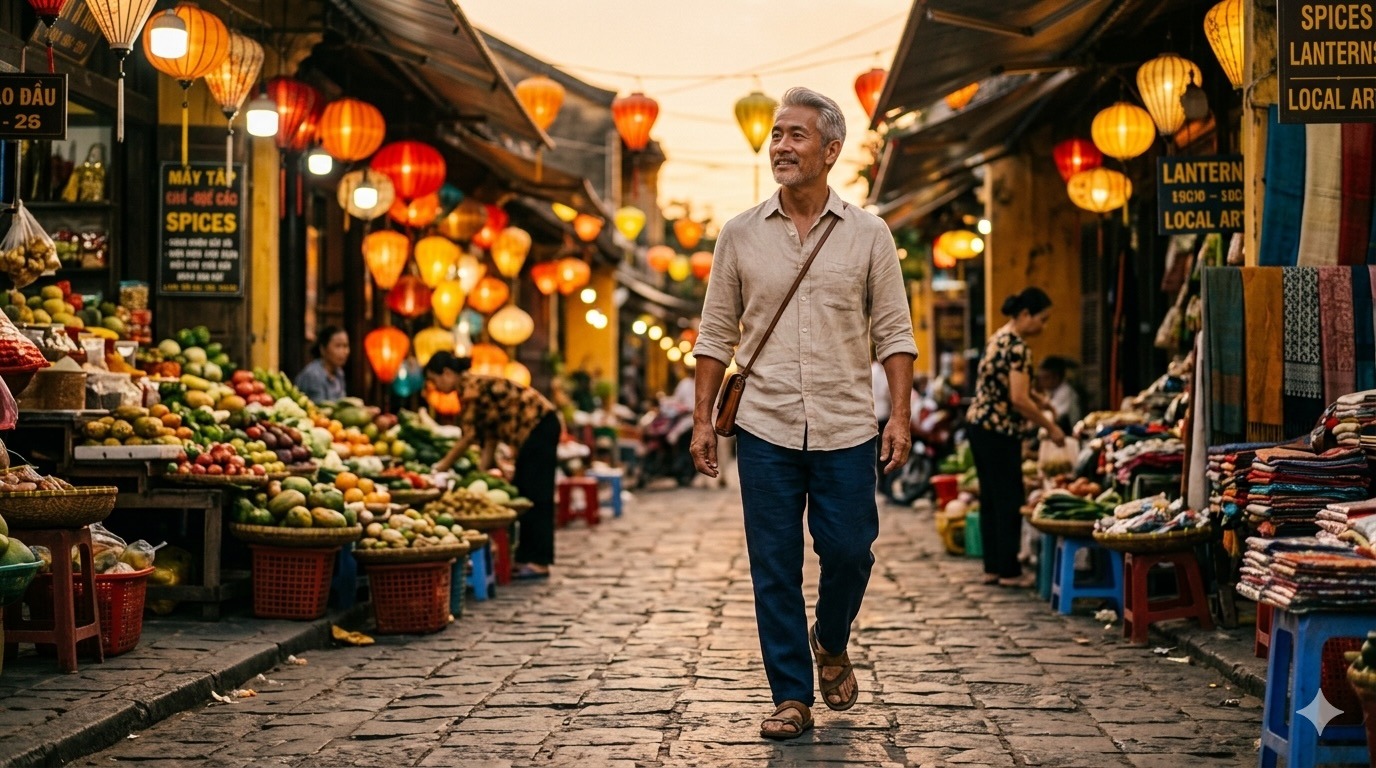
Southeast Asia delivers every ingredient on that list at a fraction of what similar experiences cost elsewhere. A week in the highlands of northern Vietnam — cool mountain air, fresh local food, walking to waterfall villages — checks every biological box the researchers identified. So does a slow boat along the Mekong, a cooking class in Chiang Mai, or a heritage walk through Melaka's Jonker Street on a quiet weekday morning.
AARP's 2026 Travel Trends survey found that adults aged 50 and over increased planned trips to Asia from 10% to 18% in a single year. The numbers suggest that people in this age group are already moving in the right direction, instinctively. The science is simply catching up with the gut feeling.
A Realistic Take
The study is careful not to overclaim, and so should we. This is emerging research — the framework is compelling and the direction is consistent with what we already know about exercise, stress, social connection, and novelty. But no single trip will reverse a decade of sedentary habits, and the researchers themselves called for stronger methods and larger studies going forward.
What the evidence does support clearly: when travel is safe, intentional, active, and restorative, it may do more than create memories. It may support your biology in ways that nothing else quite replicates, because nothing else quite combines all those inputs in the same experience.
The Bottom Line
Your retirement budget almost certainly includes allocations for supplements, gym memberships, and regular health checks. The science now makes a reasonable case for adding another line item: at least two or three intentional, restorative trips a year.
Of course, funding those trips comes down to having a retirement plan that's built for a long, active life — not just for survival. If you've wondered whether you should still be investing at this stage, we tackled exactly that question in Should You Keep Investing After Retirement?
Sitting still, it turns out, is not a longevity strategy.
Book the trip. Walk the streets. Eat the food. Your cells will thank you.
Source: Hu, F., Wen, J., Zheng, D., Ying, T., Hou, H., & Wang, W. (2024). The Principle of Entropy Increase: A Novel View of How Tourism Influences Human Health. Journal of Travel Research, 64(3), 752. ECU press release via ScienceDaily, May 4, 2026.
Disclaimer: This article is for informational and educational purposes only and does not constitute medical advice. Always consult your physician before making changes to your health or travel routines.

Address
Blk 8 Cantonment Close
SIngapore