Visa rules change all the time. Stay legal by checking requirements for Asia's Travel and Retirement Visas. Updated July 2026.
The 20-Minute Walk That's Beating the Gym for Seniors — New Research Explained
A landmark study of 72,174 people found that just 4,000–4,500 steps a day — about 20 minutes of walking — delivers half the benefit of a full gym routine. Here's what the science says, and why your morning walk is more powerful than you thought.
USEFUL MEDICAL KNOWLEDGE
6/2/20266 min read

The gym industry has a very good marketing department.
Somehow, over the past few decades, the idea lodged itself firmly in our heads that serious health improvement requires a serious setting — machines, memberships, a bag you carry out of the house. Everything else, the thinking goes, is just maintenance at best.
A study published in the British Journal of Sports Medicine — one of the largest of its kind ever conducted — is pushing back on that quite firmly.
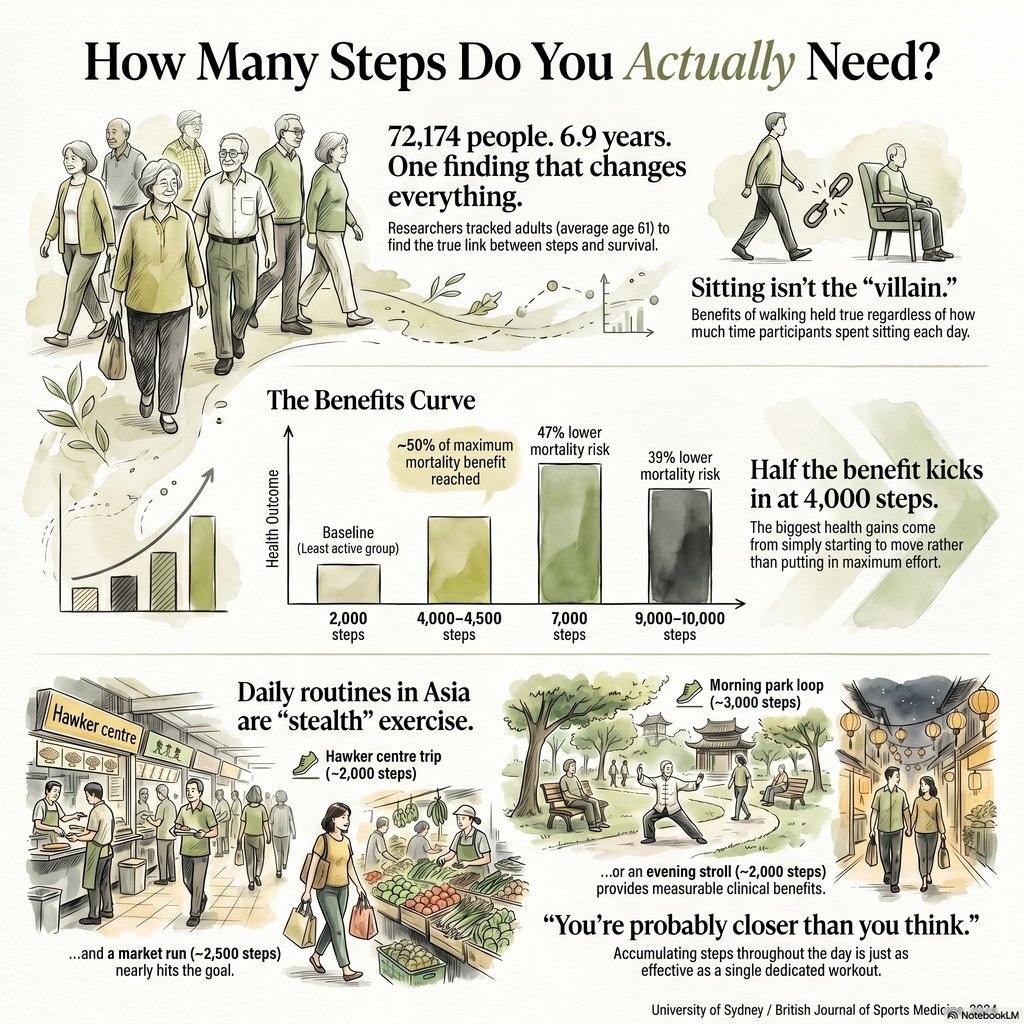
The headline finding: walking just 4,000 to 4,500 steps a day, which takes most people roughly 20 to 25 minutes, delivers approximately half the mortality and cardiovascular benefit of the most active participants in the study. And those most active participants weren't doing spin classes. They were walking 9,000 to 10,000 steps a day.
Before we get into the numbers — here's a quick, trustworthy three-minute overview from Mayo Clinic on why walking may be the most underrated health tool most of us already own:
The Study — 72,174 People, Nearly Seven Years
Researchers at the University of Sydney's Charles Perkins Centre fitted 72,174 adults with wearable accelerometers — devices that track movement with far more precision than a phone app or step counter — and followed them for an average of 6.9 years. The average participant was 61 years old. Fifty-eight percent were women.
The results, published in the British Journal of Sports Medicine, were striking in both what they confirmed and what they revealed.
At the top end: reaching 9,000 to 10,000 steps a day was associated with a 39% lower risk of dying from any cause and a 21% lower risk of cardiovascular disease compared to the least active participants.
But the more useful finding for most people — including most of us reading this — was what happened at the lower end of the scale.
At just 4,000 to 4,500 steps a day, participants were already capturing roughly half of those maximum benefits. The curve was steep early, and then it flattened. Which means the biggest gains don't belong to the people putting in the most effort. They belong to the people who simply started moving.
Lead author Dr. Matthew Ahmadi and senior author Professor Emmanuel Stamatakis were careful to note that the relationship held regardless of how much time participants spent sitting each day. Sedentary time, by itself, was not the villain — not moving was.
Why 20 Minutes Is the Number Worth Remembering
Most adults walk approximately 80 to 100 steps per minute at a comfortable pace. That means 4,000 steps takes somewhere between 40 and 50 minutes — unless you're already walking as part of daily life.
But here's the thing: most people in the study who were reaching 4,000 steps weren't doing it in a single dedicated walk. They were getting it through their day — a trip to the market, a walk to the bus stop, a loop around the neighbourhood after dinner.
If your current baseline is low, a single deliberate 20-minute walk stacked on top of ordinary daily movement gets you there. That's the prescription the data supports.
And the additional studies coming out of 2025 reinforce this from different angles:
An October 2025 study found that walking in uninterrupted bouts of 10 to 15 minutes was associated with cutting heart disease risk by roughly two-thirds. Not because length matters more than total steps — but because continuous walking gets your heart rate into a productive zone in a way that scattered steps do not.
A July 2025 analysis found that 7,000 steps a day was associated with a 47% reduction in premature death. Again, the same message: the big return comes well before you hit the targets fitness apps tend to push.
The Sitting Question (Everyone Asks It)
It's worth addressing directly, because it comes up every time walking research is published: Does this cancel out the hours I spend sitting?
The University of Sydney study was specifically designed to answer this. Their conclusion: steps and sitting are largely independent variables. Moving more helps you regardless of how much you sit. Sitting more doesn't undo the benefit of your daily walk.
This is genuinely good news for people who work at desks, spend long flights in transit, or simply find themselves sedentary for stretches during the day. The walk you took this morning still counts. The steps you take after dinner still count.
The advice to "break up sitting time" isn't wrong — there are separate and real benefits to avoiding long, unbroken periods of inactivity. But if your primary goal is longevity and cardiovascular health, the research is pointing at one lever above all others: accumulate steps.
What This Means If You're Over 55
If you're already walking regularly — even in a modest, unstructured way — you are almost certainly doing more than you think. The average participant in the University of Sydney study was already at 6,222 steps a day, and already seeing meaningful benefit from that baseline.
If you've felt that your walking "doesn't count" because it isn't structured exercise, this research is a direct correction of that assumption. A 20-minute walk in the morning before coffee. A loop around the block after lunch. A slightly longer route to wherever you're going. These are not consolation prizes for people who haven't made it to the gym. For cardiovascular health and long-term survival, they are measurably, clinically effective.
For those of us in Asia, this is also worth noting practically: the way many people in Singapore, Penang, Hanoi, and Chiang Mai naturally move through the day — to the hawker centre, through the wet market, around the temple grounds — may be doing more for longevity than a monthly gym membership that gets used twice.
The data supports what felt like common sense for generations before fitness became an industry.
If you're interested in layering structured exercise on top of your walking habit — particularly around joint health, which becomes more relevant after 60 — our guide on staying active in retirement through sport and exercise is worth reading alongside this one.
A Note on Precision
Step targets are a useful proxy, but they're not the whole picture. The research consistently finds that the quality of movement matters too — pace, terrain, and consistency over weeks and months matter more than any single day's count.
Professor Stamatakis has noted in previous work that replacing any sedentary time with even light activity produces measurable biological benefits. Walking briskly enough to raise your breathing slightly — not gasping, just working — amplifies those benefits further.
If you've been told that cardiovascular risk is something to take seriously at your age, it almost certainly is. Our earlier piece on what seniors can do to prevent a stroke connects the exercise evidence to the vascular health picture more directly.
The Bottom Line
The 10,000-steps target has always been marketing, not medicine — it originated in a Japanese pedometer campaign in the 1960s. The actual evidence has now caught up, and it tells a different story.
The meaningful threshold isn't 10,000. For most people, it's closer to 4,000 to 7,000 steps — a number that takes somewhere between 30 and 50 minutes of ordinary daily movement to reach.
That's the walk to the market and back. The evening stroll. The twenty minutes after dinner you were going to spend on your phone anyway.
No membership. No equipment. No particular schedule.
A study of 72,174 people followed for nearly seven years says this is enough to make a significant difference to how long you live, and how well your heart holds up along the way.
Lace up. Walk out. The research is on your side.
And if you're thinking about structuring the rest of retirement around a life that keeps you moving — financially, geographically, and physically — why moving overseas could be the ultimate retirement strategy is a piece worth pairing with this one. The places in Asia most likely to keep you walking are also, not coincidentally, among the most affordable places to retire well.
Sources: Del Pozo Cruz, B., Ahmadi, M., et al. (2022/2024). Prospective associations of daily step counts and intensity with mortality, cardiovascular disease and cancer. British Journal of Sports Medicine, 58(5):261. DOI: 10.1136/bjsports-2023-107221. Via ScienceDaily, April 18, 2026. Additional supporting data: Multiple 2025 cohort studies on step count thresholds and cardiovascular risk.
Disclaimer: This article is for informational and educational purposes only and does not constitute medical advice. Consult your doctor or physiotherapist before beginning or significantly changing an exercise programme, especially if you have existing cardiovascular or joint conditions.
Address
Blk 8 Cantonment Close
SIngapore