Visa rules change all the time. Stay legal by checking requirements for Asia's Travel and Retirement Visas. Updated July 2026.
The Ultimate Guide: 10 Cultural Rules Every Foreigner Must Know in Asia
Avoid cultural mistakes! Learn the 10 most crucial etiquette rules for foreigners in Asia, covering everything from 'saving face' to proper chopstick use.
TRAVEL
11/26/20254 min read
Stepping off a plane into Asia—whether it's the neon glow of Tokyo, the spice-scented air of Bangkok, or the bustling streets of Hanoi—is an electric experience. It's a continent built on ancient traditions, respect, and layered customs.
But for the traveler, these layers can feel like a maze. We all want to be respectful guests, not the loud, clueless tourist who accidentally causes offense. The truth is, a little bit of knowledge goes a very long way. Cultural sensitivity isn't about being perfect; it's about making an honest, conscious effort. It’s the difference between being tolerated and being genuinely welcomed.
When I was first living in Seoul, I once handed a business card to a colleague with one hand while chatting away. The look on his face told me everything. I’d violated a core principle of respect for hierarchy. I’ve never made that mistake again.
To help you skip the awkward moment and jump straight to connection, here are 10 essential cultural rules every foreigner must know.
10 Rules for Being a Highly Respectful Guest in Asia
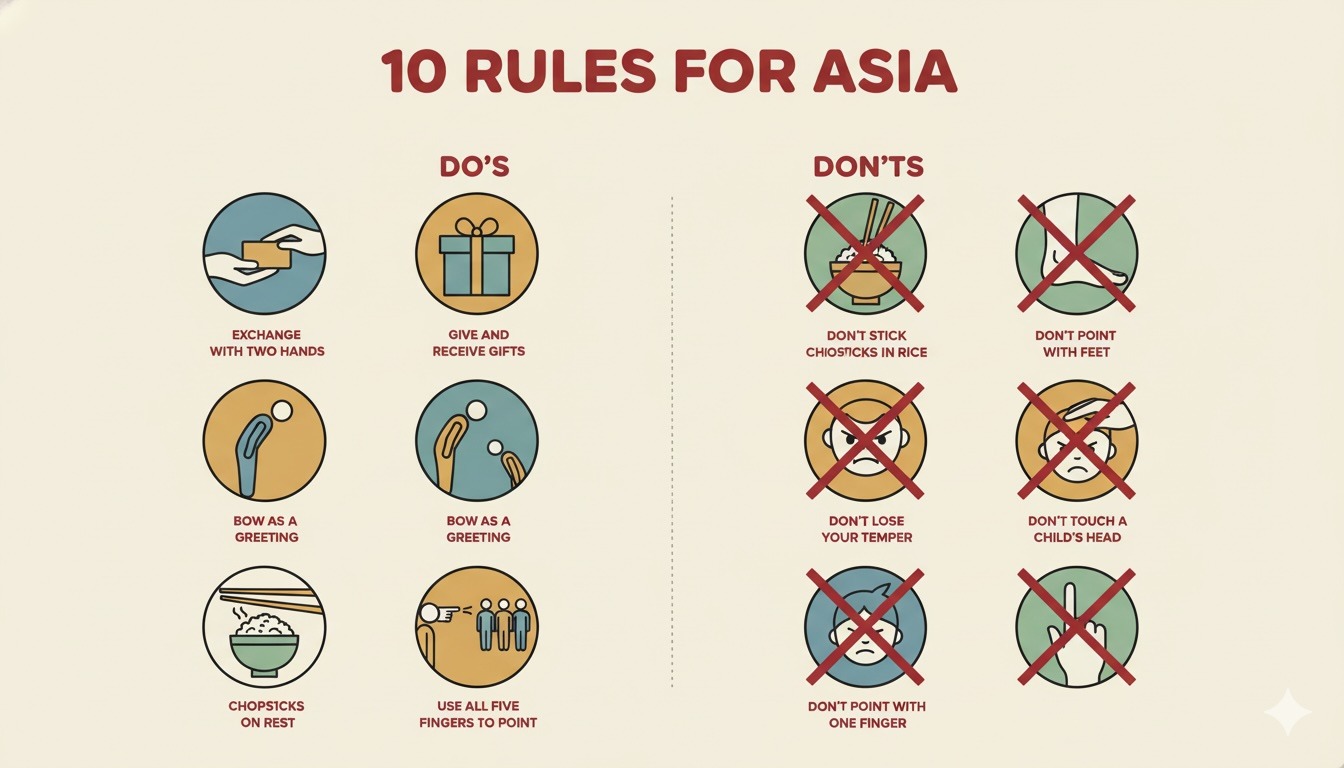
1. Master the Hand-Out (and Hand-In) In much of East and Southeast Asia, hierarchy is everything. When giving or receiving anything important—a gift, money, a business card, or even just a heavy bag—use two hands. It shows sincerity, respect, and humility. If two hands aren't possible, use your right hand, never your left (especially in Hindu or Buddhist-influenced countries, as the left hand is traditionally associated with personal hygiene).
2. Never Point with Your Feet (or Show the Soles) In many cultures, particularly Thailand and Vietnam, the head is considered sacred, and the feet are considered the lowest and dirtiest part of the body.
The Rule: Never point your feet at a person, a religious statue (especially the Buddha), or even a photograph of royalty. When sitting, make sure the soles of your feet aren't visible to others.
Data Point: According to a 2024 survey by Statista, inappropriate body language (like pointing feet or touching heads) ranks as one of the top three reported sources of offense from foreigners in Thailand.
3. Dress with Dignity (Especially at Holy Sites) Across Asia, modesty is paramount, especially when visiting temples, pagodas, or mosques.
The Rule: Shoulders and knees must be covered. For women, this often means carrying a lightweight scarf. For men, no tank tops or very short shorts. You will be denied entry to sacred spaces if you do not adhere to this.
Pro Tip: Always carry a pair of socks—you'll often be required to remove your shoes before entering.
4. Understand the Weight of 'Saving Face' This is perhaps the most important, and often misunderstood, rule, particularly in East Asian business. "Saving Face" (or mianzi) means preserving a person's reputation, dignity, and honor.
The Rule: Never publicly criticize, contradict, or embarrass someone, especially a superior or elder. Use soft language, talk in private, and provide an "out" if someone makes a mistake. Public confrontation is a sign of extreme disrespect.
5. Keep Your Emotions in Check High emotional displays—anger, intense frustration, or even very loud laughter—are often seen as disruptive and immature. Asian cultures tend to value harmony and emotional restraint. Shouting or losing your temper in public is a surefire way to lose respect.
6. Respect the Hierarchy (The Elder Goes First) In group settings, always defer to the oldest person in the room. They should be greeted first, served first, and speak first. This respect for seniority, or Sunbae-Hoobae in Korea or Senpai-Kohai in Japan, is deeply ingrained.
7. Don't Touch the Head Remember the head is sacred? This applies especially to children. Resist the urge to pat a child on the head, even as a gesture of affection. It's considered bad offence especially amongst the Thais and Burmese.
8. Chopstick Etiquette is Not Optional If you're using chopsticks, there are three deadly sins; especially in China, Malaysia, Singapore, Hong Kong and Taiwan:
1) Sticking them upright in a bowl of rice (it resembles incense at a funeral offering).
2) Using them to point at people.
3) Passing food from one pair of chopsticks to another (another funerary rite).
9. Be Reserved with Public Displays of Affection (PDA) While holding hands is generally fine, excessive public kissing, hugging, or fondling is frowned upon in most non-Westernized parts of Asia. It's often viewed as inappropriate and immature.
10. Offer a Gift (and Don't Open it Immediately) If you are invited to a local's home, always bring a small gift. When receiving a gift, it is polite to initially decline it once or twice, only accepting on the third offer. Crucially, do not open a gift immediately unless specifically asked to. This is considered greedy; the host will usually want you to enjoy the gift later, in private.
By embracing these 10 rules, you won't just avoid awkward situations; you will unlock genuine cultural exchanges. Respect is the universal currency, and it buys you a much richer travel experience.
Have a great cultural tip from your travels in Asia? Share your best advice for respectful travel! If you found this useful, share it with a friend planning their first trip East.
Disclaimer: This article is for informational purposes only and does not constitute professional advice. Cultural rules can vary drastically by region, and this guide should be used as a general framework for respectful behavior.

Address
Blk 8 Cantonment Close
SIngapore