Visa rules change all the time. Stay legal by checking requirements for Asia's Travel and Retirement Visas. Updated July 2026.
What are the most meaningful ways to celebrate Ramadan 2026 in Asia?
Discover how to celebrate Ramadan 2026 in Asia meaningfully. From Singapore's bazaars to global Zakat trends, find your spiritual path today.
FESTIVALS
2/23/20265 min read

Ramadan 2026 in Asia: A Beginner's Guide to the Holy Month
Have you ever tried to explain to your stomach that the delicious smell of sizzling satay drifting through the air is completely off-limits for the next six hours? Welcome to Ramadan 2026 — one of the most meaningful times of year for nearly two billion Muslims around the world.
So, What Exactly Is Ramadan?
Ramadan 2026 began on the evening of Wednesday, 18 February 2026 (with some communities starting on 17 or 19 February depending on moon sighting) and is expected to conclude around the evening of 19–21 March 2026
Ramadan is the ninth month of the Islamic lunar calendar, and for Muslims, it is the holiest time of the year. But why?
According to Islamic belief, it was during this month that the Quran — the holy scripture of Islam — was first revealed to the Prophet Muhammad (peace be upon him) by God (Allah in Arabic) through the angel Gabriel. This makes Ramadan a time of immense spiritual significance, not just a month of not eating.
Because Islam uses a lunar calendar (based on the cycles of the moon rather than the sun), Ramadan shifts back by roughly 10 to 11 days each year. In 2026, it falls during late winter in the Northern Hemisphere — which actually means slightly shorter fasting days and cooler evenings for much of Asia. A welcome relief for those observing the fast!
This year is formally known as Ramadan 1447 AH — "AH" stands for Anno Hegirae, the Islamic calendar's equivalent of "AD," counting from the year the Prophet Muhammad migrated from Mecca to Medina.
The Five Pillars: Where Ramadan Fits In
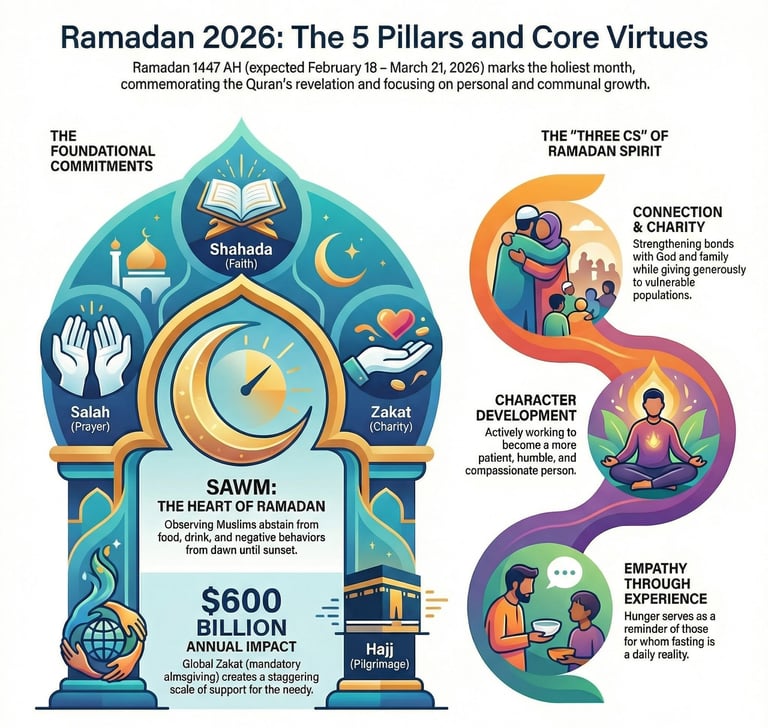
To understand why Ramadan matters so deeply, it helps to know that Islam is built around five core practices, known as the Five Pillars of Islam. Think of them as the foundational commitments of a Muslim's life:
Shahada — the declaration of faith ("There is no god but God, and Muhammad is His messenger").
Salah — praying five times a day.
Zakat — giving a portion of one's wealth to those in need.
Sawm — fasting, which is the pillar at the heart of Ramadan.
And Hajj — making a pilgrimage to Mecca at least once in a lifetime, if able.
Ramadan is where the fourth pillar, Sawm, comes to life. From the first light of dawn until sunset each day, observing Muslims abstain from eating, drinking, smoking, and negative behaviours. This is not simply about hunger — it is a full-body, full-heart commitment to self-discipline, gratitude, and closeness to God.
What Are People Actually Doing Each Day?
A typical day in Ramadan follows a beautiful rhythm. Before dawn, families wake for Suhoor — a pre-fast meal eaten before the day's fasting begins. At sunset, the fast is broken with Iftar, traditionally starting with a date and water, followed by a shared meal that often becomes a joyful community gathering. Throughout the month, Muslims increase their prayers, read the Quran, and focus on acts of kindness and charity.
The "Three Cs" that define the spirit of Ramadan are Connection (with God, family, and community), Charity (giving generously to those in need), and Character (working to become a more patient, humble, and compassionate person).
Where Is Ramadan Celebrated Across Asia?
Asia is home to the vast majority of the world's Muslim population, and the month looks and feels a little different depending on where you are.
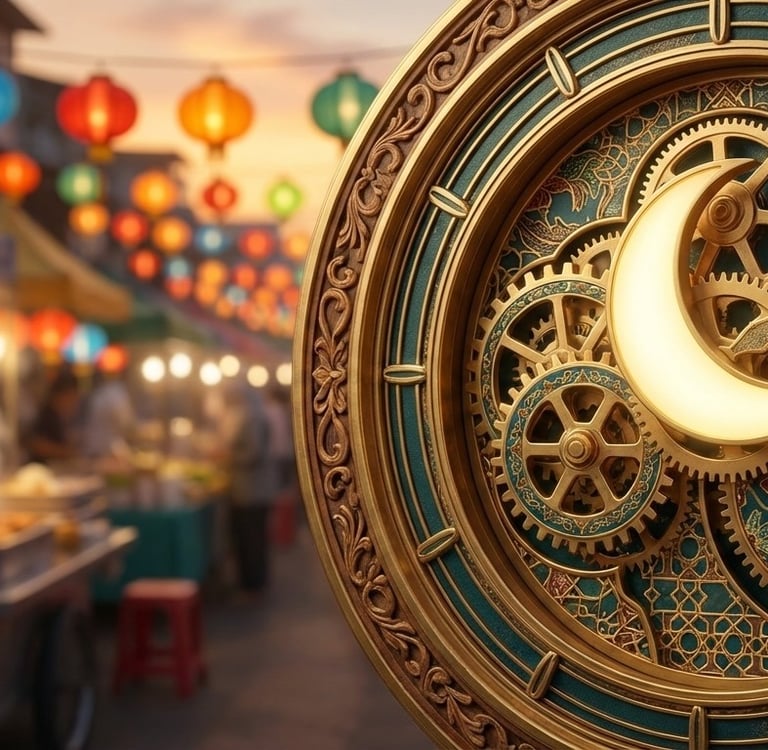
Southeast Asia is perhaps where Ramadan has its most festive, communal atmosphere. In Singapore, the neighbourhoods of Geylang Serai and Kampong Gelam transform into vibrant night bazaars, glowing with lights and overflowing with food stalls, clothing vendors, and families out for their Iftar evening. The mood is warm, generous, and deeply communal.
In Indonesia — the country with the world's largest Muslim population — a beloved tradition called Ngabuburit takes over the late afternoon hours. People visit local markets to browse Takjil (small snacks and drinks to break the fast), filling the time before sunset with community and anticipation.
Malaysia similarly comes alive with Ramadan bazaars in every city and town, where the smells of grilled fish, kuih (traditional cakes), and teh tarik (pulled tea) fill the evening air.
Moving to South Asia, the observance takes on a quieter, deeply devotional character. In Pakistan and Bangladesh, mosques are full to capacity for the special Tarawih night prayers that are unique to Ramadan, and the sound of the call to prayer echoes across cities at Iftar time in a way that is genuinely moving even for non-Muslim visitors.
Bangladesh is also home to the Rohingya refugee community, one of the most vulnerable populations in the region, for whom international Ramadan charity efforts are particularly vital.
In Central Asia — countries like Kazakhstan, Uzbekistan, and Kyrgyzstan — Ramadan is observed with a blend of Islamic tradition and local Central Asian culture. And across the Middle East's Asian borders, including countries like Turkey, Jordan, and the Gulf states, Ramadan is a national experience, with businesses adjusting hours, streets decorated with lanterns, and entire cities shifting to a nocturnal rhythm.
The Charity Dimension: More Than Just Giving
One of the most powerful aspects of Ramadan for newcomers to understand is its emphasis on generosity. The third pillar of Islam, Zakat, requires Muslims who are financially able to give a fixed portion (2.5%) of their savings to those in need. During Ramadan, many choose to fulfil this obligation, and voluntary charity (Sadaqah) also surges dramatically.
The scale is staggering — Muslims worldwide donate an estimated $550 to $600 billion in Zakat annually, according to Islamic Relief. In 2026, organisations like Islamic Relief are working to provide food packs to over 535,000 people across 34 countries, with a significant focus on high-need areas across Asia. By feeling hunger themselves, observers are reminded of those for whom going without food is not a spiritual choice but a daily reality.
How Can a Non-Muslim Respectfully Engage?
If you live in or are visiting an Asian country during Ramadan, here are a few simple ways to engage respectfully and meaningfully. Avoid eating or drinking in public spaces, particularly in countries where this is customary or legally expected, such as parts of Malaysia. If you are invited to an Iftar meal, accept — it is one of the most generous and welcoming gestures you can receive. Greet Muslim friends with Ramadan Mubarak (Blessed Ramadan) or Ramadan Kareem (Generous Ramadan). And if a colleague seems quieter or lower-energy during daylight hours, a little extra patience goes a long way.
Even if you are observing entirely from the sidelines, the spirit of Ramadan — empathy, generosity, and community — is something anyone can appreciate and even quietly participate in.
Whether you call it Selamat Berpuasa in Malay, Ramzan Mubarak in Urdu, or simply "that time of year when the bazaars smell incredible," Ramadan 2026 is an invitation to slow down, be more grateful, and look out for the people around you. The food at Iftar, as one wise satay uncle once put it, really does taste better when you've earned it.
How are you planning to give back this Ramadan? Leave a comment below or share your favorite Iftar spot!
Disclaimer: This article is for informational purposes only and does not constitute professional advice.


Address
Blk 8 Cantonment Close
SIngapore