Visa rules change all the time. Stay legal by checking requirements for Asia's Travel and Retirement Visas. Updated July 2026.
What is "Active Aging" and why is it taking over Asian retirement?
Discover how "Active Aging" is revolutionizing retirement in Asia. From smart-tech homes in Seoul to silver education in China—see what's next for 2026.
RETIREMENT PLANNINGGEO-ARBITRATE RETIREMENT
2/8/20266 min read
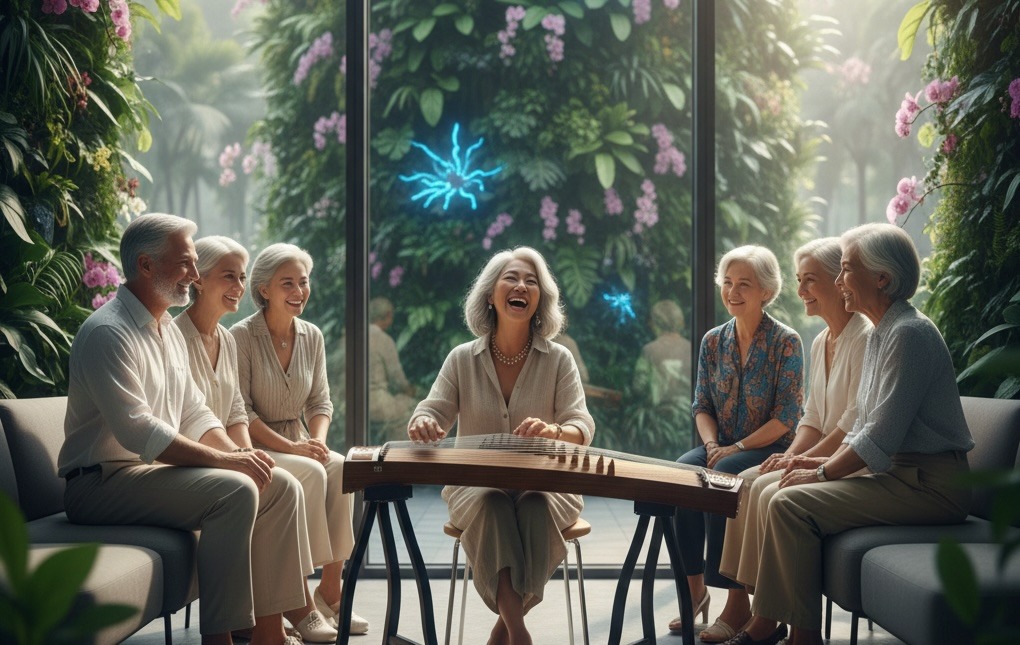
Let’s be honest: the old-school image of retirement—sitting in a rocking chair, staring at a beige wall, and waiting for the grandkids to call—is officially "so 20th century." In Asia, a region that is aging faster than a high-speed rail from Tokyo to Osaka, a new revolution is brewing. It’s called Active Aging, and it’s transforming the "Golden Years" into a "Platinum Power-Play."
The "New Old": Not Your Grandma’s Retirement
Active aging isn't just about doing a bit of Tai Chi in the park (though that’s still great). According to the World Health Organization (WHO), active aging is the process of optimizing opportunities for health, participation, and security to enhance quality of life as people age. In short: it’s about staying in the driver’s seat of your own life.
In places like Singapore (新加坡) and Japan (日本), the "Active" part of the equation is literal. We’re talking about retirees starting e-commerce side-hustles, taking university courses, and living in "Resort-style" communities that feel more like a Club Med than a care facility.
Discover how "Active Aging" is revolutionizing retirement in Asia. From smart-tech homes in Seoul to silver education in China—see what's next for 2026.
The "New Old": Not Your Grandma's Retirement
In places like Singapore and Japan, the "Active" part of the equation is literal. We're talking about retirees starting e-commerce side-hustles, taking university courses, and living in "Resort-style" communities that feel more like a Club Med than a care facility.
I remember visiting a "Silver Cafe" in Tokyo last year. The barista, a 74-year-old retired engineer named Kenji, told me he didn't take the job for the money. "I'm here for the latte art and the gossip," he laughed. "If I stayed home, my brain would turn into tofu!"
Kenji's not alone. Last month I met Mrs. Chen in Beijing—68 years old, learning video editing on WeChat so she could make travel vlogs. When I asked her why, she looked at me like I'd asked why the sky is blue. "Why should young people have all the fun?" Fair point, Mrs. Chen. Fair point.
Why Asia? Why Now?
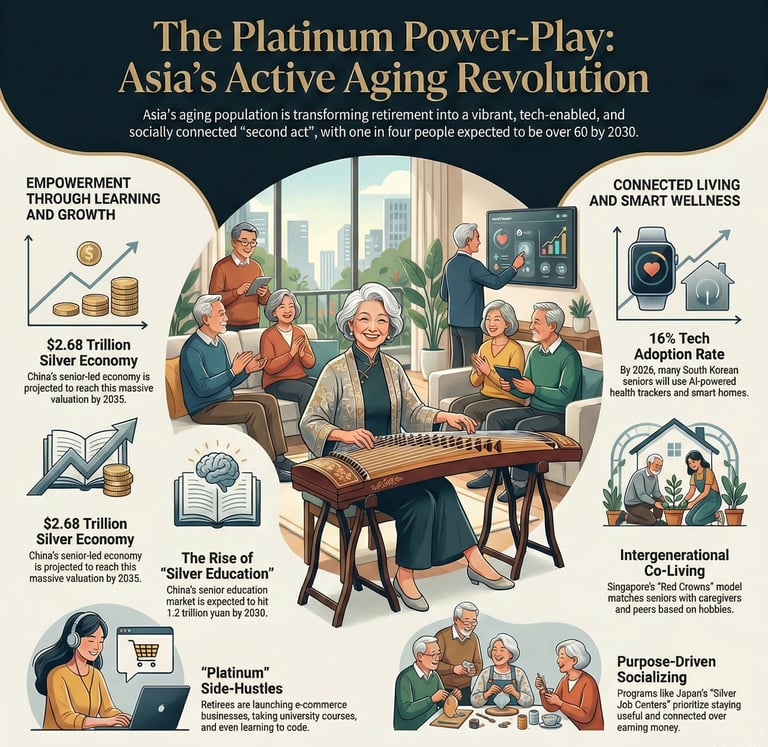
Here's the thing: Asia is getting older, fast. By 2030, one in four people will be over 60. That's not a prediction—that's already happening. Japan, Hong Kong, and South Korea are leading the pack, which is both a challenge and an opportunity.
The Money Talk: Nearly 25% of China's total savings are held by people over 60. And they're not stuffing it under mattresses. They're spending it on travel, wellness products, online courses, and lifestyle upgrades. China's silver economy alone is projected to hit $2.68 trillion by 2035. When I tell people this, they're shocked. "Wait, seniors have that kind of money?"
Yep. And they're using it.
The Tech Factor: In South Korea, 16% of seniors will be using AI-powered health trackers and smart-home systems by 2026. My friend in Seoul has a smartwatch that monitors her heart rate, sleep patterns, and reminds her to take her meds. She jokes that her watch knows more about her health than her doctor does. The watch also judges her when she eats too much kimchi, apparently.
The Three Pillars (Without the Boring Stuff)
1. Never Stop Learning
Education isn't just for kids anymore. In China, the "Silver Education" market is expected to hit 1.2 trillion yuan by 2030. From digital literacy to photography to barista training (looking at you, Kenji), seniors are signing up for everything.
There's even a growing trend of seniors learning to code. I met a 71-year-old former accountant in Taipei who's now building simple apps. When I asked him why, he said, "Because my grandson kept saying I don't understand technology. Now I'm making an app better than he can." Petty? Maybe. Impressive? Absolutely.
2. Living Together (Without the Drama)
Modern retirement isn't about being stuck in some isolated facility watching paint dry. New communities are popping up where senior housing is built right next to preschools and universities. Imagine: grandma teaching kids calligraphy while teenagers help her figure out Instagram. It's happening.
Singapore has these co-living arrangements called Red Crowns—basically, four seniors share a home with two caregivers, matched by hobbies and interests. One house I visited had four former teachers. They'd turned their living room into a mini-library and hosted neighborhood kids for reading sessions twice a week. The energy in that place? Electric.
In Japan, some train services now have special carriages for seniors with softer lighting, accessible bathrooms, grab bars, and on-board medical staff. Over 1 million passengers have used them. One woman told me she'd avoided traveling for years because she was worried about emergencies. "Now I visit my daughter in Kyoto every month," she said. "The train staff know me by name!"
3. Wellness That Actually Works
Forget those depressing doctor visits where they just tell you what you can't do anymore. The new wellness programs focus on what you can do—and how to keep doing it longer.
Thailand and Malaysia are becoming global hubs for health and wellness retirement, offering everything from DNA-based nutrition plans to hydrotherapy. But you don't need to move to Bangkok to benefit. In China, 70% of seniors are already doing some form of regular exercise, whether it's traditional Tai Chi, walking groups, or even digital fitness classes.
The shift is from "treating sickness" to "staying healthy." Revolutionary? Maybe. Common sense? Definitely.
Real Stories From the Ground
Japan's Silver Job Centers: These government-funded centers match older adults with temporary gigs—everything from tutoring to light delivery work. It's not about making big money. It's about staying connected and feeling useful. One 76-year-old man I spoke with delivers meals to homebound seniors three mornings a week. "They're older than me," he grinned, "so I'm still the young guy!"
Singapore's Micro-Jobs: Healthy seniors can sign up for "bite-sized" tasks like accompanying frailer neighbors to doctor's appointments or helping with grocery shopping. One participant told me she makes about $300 a month but that's not why she does it. "My neighbor Mrs. Lim makes me laugh. We go to her checkups, then we get bubble tea. Best job I've ever had."
Beijing's Community Program: Over 1,500 seniors aged 80+ get meal delivery, medical supplies, and daily task assistance, helping them stay independent in their own homes. One lady joked that the delivery guy is more reliable than her own kids. (Her kids probably weren't thrilled to hear that, but hey—truth hurts.)
The Challenges (Because It's Not All Roses)
Let's be real for a second. Active aging sounds great, but there are bumps in the road.
The Tech Struggle: Not everyone is comfortable with apps and online banking. In Japan, half of seniors still don't use the internet. My own aunt in Kuala Lumpur refuses to touch a smartphone. "Too many buttons," she says. We're working on her.
The Money Thing: Not everyone has a fat pension. About 34% of seniors face real affordability challenges when it comes to healthcare and wellness programs.
Loneliness is Real: In Japan, over 28,000 people aged 65+ died alone at home in just six months during 2024. That number haunts me. All the fancy programs in the world don't mean much if you're sitting alone at home with no one to talk to.
Why Asia? Why Now?
The shift is being driven by a perfect storm of demographics and "Silver Economy" spending power.
The Demographic Squeeze: According to a 2025 report by the Asian Development Bank, one in four people in Asia will be over 60 by 2030.
The Longevity Dividend: Recent data from the ASEAN Centre for Active Ageing (2024) shows that while life expectancy is rising, people are spending up to 10 years with some form of impairment. Active aging aims to shrink that gap—adding life to years, not just years to life.
Tech Integration: In South Korea (대한민국), a 2025 HKTDC Research report highlights that 16% of seniors will be using advanced "Gerontechnology"—think AI-powered health trackers and smart-home safety systems—by 2026.
The Bottom Line
Active aging is the ultimate "rebrand" of getting older. It’s about maintaining Ikigai—that Japanese concept of a "reason for being." Whether it's volunteering, traveling, or finally learning how to code, the goal is to remain a "valuable agent of change" in society.
See how seniors are taking part in long distance running events
Seniors are actively planning for passive income even in retirement
Seniors seek out geo-arbitrate retirement in Asia
Ready to plan your next act? Check out our latest guides on Silver Economy investments or leave a comment below: What does "Active Aging" mean to you?
Disclaimer: This article is for informational purposes only and does not constitute professional financial or medical advice.

Address
Blk 8 Cantonment Close
SIngapore