Visa rules change all the time. Stay legal by checking requirements for Asia's Travel and Retirement Visas. Updated July 2026.
Which Meditation is Best for Seniors? 3 Techniques for Pain, Mobility, and Anxiety
Experts recommend 3 meditation types for seniors: Chair Mindfulness, Guided Imagery, and Loving-Kindness. Find the best technique to manage chronic pain, anxiety, and limited mobility safely.
FITNESS AND EXERCISE
1/16/20263 min read


If you’re over 60, you may feel overwhelmed by the sheer number of meditation apps, classes, and jargon—Vipassana, Zazen, Transcendental Meditation (TM). Which one is right for an aging body, especially one dealing with limited mobility, chronic pain, or increased anxiety?
The best meditation for seniors is not the most difficult, but the most adaptable and the most evidence-based for age-related health issues.
We’ve consulted the data and distilled the vast landscape of meditation down to the three most suitable and highly recommended techniques for the golden years. These methods require minimal physical effort, can be done from a chair or bed, and offer significant, measurable relief.
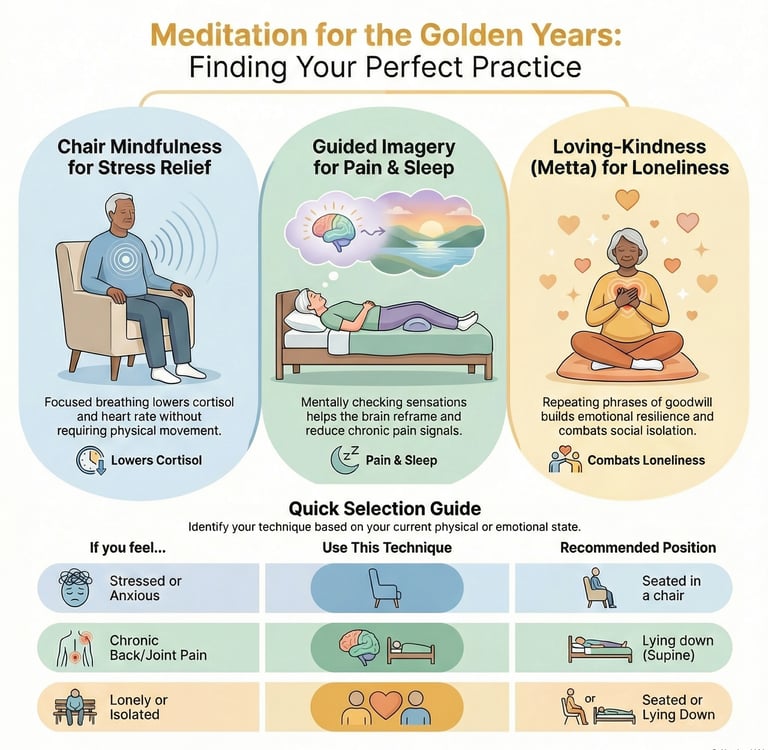
🥇 Technique 1: Chair Mindfulness (Mindful Breathing)
Best for: Stress Reduction, Managing Anxiety, and Developing Focus.
Mindfulness is the practice of paying attention to the present moment without judgment. For seniors, this simple technique becomes a powerful antidote to anxiety (which often involves worrying about the future) and rumination (which involves dwelling on the past).
Why It’s Perfect for Seniors:
Ultimate Adaptability: The practice revolves around focusing on your breath, which requires no movement. You can practice effectively while seated in a dining chair, relaxing in a recliner, or even lying in bed.
Stress Hormone Reduction: Consistent mindful breathing has been scientifically shown to slow the heart rate and lower the production of cortisol, the body's main stress hormone. This leads to a profound sense of inner calmness and balance.
Starting Point: Start with a simple Mindful Breathing exercise:
Sit comfortably with your feet flat on the floor or rest your back against a wall.
Place a gentle hand on your abdomen.
Focus entirely on the sensation of the breath entering and leaving your body. Note the cool air in your nostrils and the warmth on the exhale.
When your mind inevitably wanders (it will!), simply acknowledge the thought and gently return your attention to the breath.
🥈 Technique 2: Guided Imagery & Body Scan
Best for: Chronic Pain Management, Improved Sleep Quality, and Deep Relaxation.
The Body Scan is a classic mindfulness exercise, and Guided Imagery is its imaginative cousin. Both are "no-effort" practices where you are led by a voice through a sequence of mental focusing.
Why It’s Perfect for Seniors:
Pain Relief through Reframing: The Body Scan involves mentally checking in with different parts of the body, noticing sensations (including pain) without judgment. This non-reactive approach has been shown to help the brain reframe its response to chronic pain signals, reducing the intensity of discomfort (Source: Journal of Pain data).
Sleep Improvement: Guided imagery often focuses on tranquil, peaceful scenes (e.g., a quiet forest, a calm ocean). When practiced before bed, this actively lowers heart rate and blood pressure, creating the ideal physiological environment for falling asleep and staying asleep.
Zero Physical Strain: This technique is ideally practiced lying down, which is critical for individuals with severe mobility issues or conditions that make sitting upright painful (like advanced back pain or knee arthritis).
🥉 Technique 3: Loving-Kindness Meditation (Metta)
Best for: Reducing Loneliness, Improving Emotional Resilience, and Managing Anxiety.
Loving-Kindness Meditation (LKM or Metta) is a practice that focuses on cultivating feelings of goodwill, warmth, and compassion towards yourself and others. For many seniors who may be dealing with grief, social isolation, or caregiver burnout, LKM offers immense emotional support.
Why It’s Perfect for Seniors:
Emotional Focus: Unlike other types that focus on the breath or body, LKM focuses on positive emotions, which can be an easier and more instantly rewarding practice for beginners.
Combating Isolation: The practice involves extending kindness outward—to yourself, to loved ones, to neutral people, and even to difficult people. This cultivation of connection is crucial for seniors who may be experiencing increased loneliness or loss.
Simple Script: A typical LKM session follows a simple internal script, often using phrases like:
"May I be safe."
"May I be happy."
"May I be healthy."
"May I live with ease."
You start with yourself, then move to loved ones, and gradually expand the circle outward.
Quick Comparison: Which Technique to Start With?
Recommended Technique
I feel stressed/anxious. (Chair Mindfulness)
Seated in a chair. Instantly calms the nervous system via controlled breathing
I have chronic back/joint pain. (Guided Imagery & Body Scan)
Lying down (Supine). Reframes the brain's relationship with pain signals.
I feel lonely or isolated. (Loving-Kindness (Metta))
Seated or Lying Down. Actively cultivates positive emotions and connection.
Ready to start practicing? Explore our resource section for free guided audio recordings and apps specifically designed for senior-friendly Chair Mindfulness!
Disclaimer: This article is for informational purposes only and does not constitute professional medical advice. Always consult with your healthcare provider about managing pain or anxiety.
Address
Blk 8 Cantonment Close
SIngapore