Visa rules changes all the time. Stay legal by checking requirements for Asia's Travel and Retirement Visas. Updated July 2026.
Why a Fall After 60 Is So Dangerous — And the 7 Ways to Make Sure It Doesn't Happen
Falls are the leading cause of injury-related death in adults over 65. But most falls are preventable. Here's what actually causes them, and the seven evidence-backed strategies — from Tai Chi to medication reviews to bathroom grab bars — that reduce your risk significantly.
USEFUL MEDICAL KNOWLEDGE
6/2/20268 min read
Here is a statistic that doesn't get nearly enough attention: a fall that breaks a hip has roughly the same one-year mortality rate as a heart attack.
Not a fall from height. Not a dramatic accident. A trip on a loose rug. A moment of dizziness getting up too fast. A bathroom floor that was slightly too slippery.
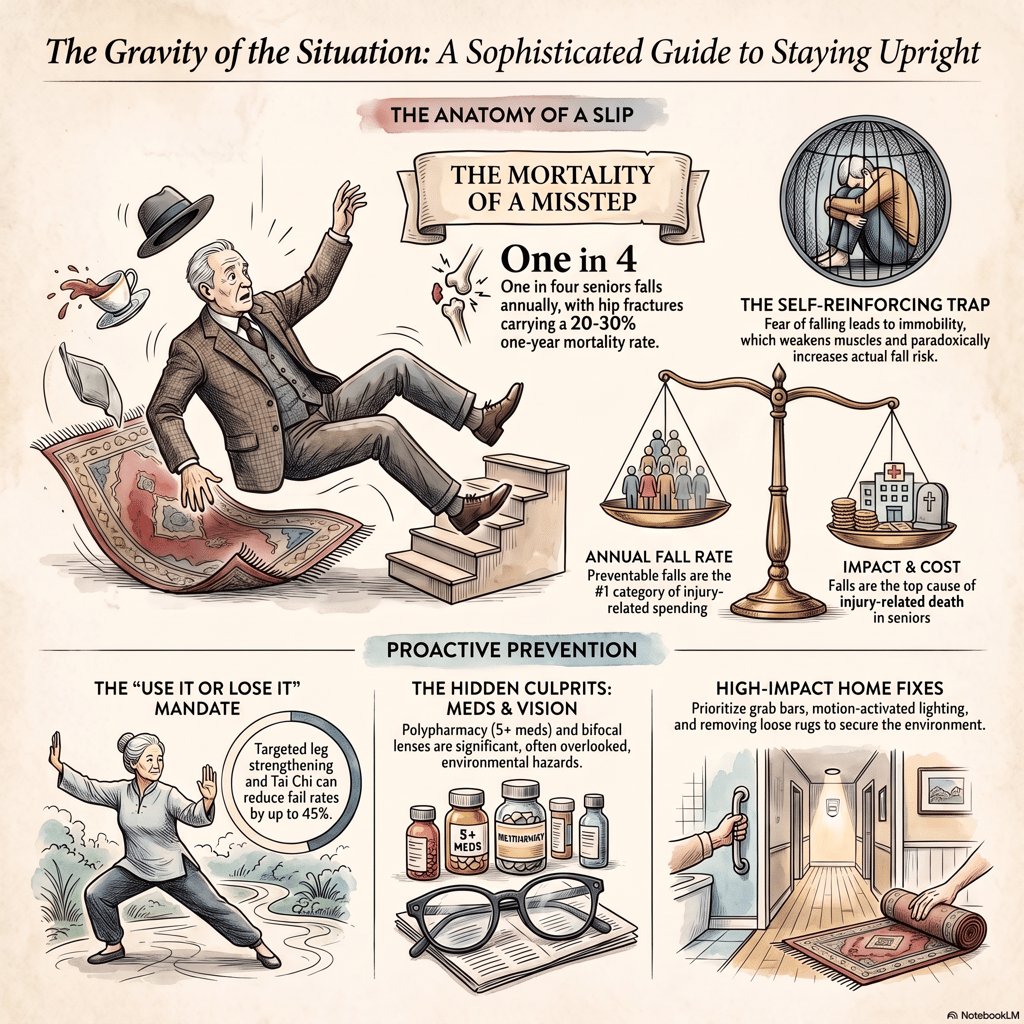
One in four adults over 65 falls at least once a year. Falls are the leading cause of injury-related death in that age group — and the leading cause of hospitalisation. In 2026, global healthcare systems are spending more on fall-related injuries among older adults than on any other category of preventable harm.
And the cruelest part: the fear of falling often causes people to move less, which weakens the muscles that prevent falling, which increases the actual risk. A self-reinforcing trap that starts with a single stumble.
Here's what the research says about breaking that cycle — before it begins.
Why Falls Are So Dangerous After 60
The injury itself is often not the whole story. A broken hip in someone over 70 triggers a cascade: surgery, immobility, potential complications (pneumonia, blood clots, pressure sores), rapid deconditioning, and — critically — a loss of confidence that permanently reduces activity levels.
Studies consistently find that between 20% and 30% of people who suffer a serious fall and hip fracture die within a year. Not all of those deaths are directly caused by the fracture. Many are caused by the consequences of the immobility that follows.
Which is why the framing matters: preventing a fall isn't just about avoiding a bruise. It's about protecting the trajectory of the next decade.
The good news — and there genuinely is a lot of it — is that most falls are preventable. Not some of them. Most of them. The research points to a clear, manageable set of causes, and a well-evidenced set of solutions for each one.
1. Strength and Balance Training
This is the single most evidence-backed intervention. Muscle weakness — particularly in the legs, hips, and core — is the most common underlying cause of falls. When a foot catches slightly, or a surface is uneven, it's lower body strength and balance reflexes that determine whether you catch yourself or hit the floor.
The Otago Exercise Programme, developed and trialled in New Zealand, found that a targeted programme of leg strengthening and balance exercises reduced fall rates in older adults by approximately 35%. It involves simple moves — standing on one leg, heel raises, side steps — done three times a week, progressively increasing in difficulty.
Tai Chi has its own substantial evidence base: multiple reviews have found it reduces fall risk by 20–45%, partly through improved balance and partly through better proprioception — your body's sense of where it is in space. It's also something you can do in a park, in a community centre, or at home following an online class, which matters for compliance.
The core principle: use it or lose it. Muscles that aren't challenged don't maintain their strength. Any regular physical activity that involves standing, shifting weight, and moving through space is working on this problem.
Our guide on staying active in retirement through sport and exercise covers the broader framework for building a sustainable movement practice in your 60s and beyond.
2. Medication Review
This one surprises people, but it's one of the most actionable items on this list.
Certain medications — or combinations of medications — significantly increase fall risk. The culprits include sleeping pills and sedatives, anti-anxiety medications (benzodiazepines), blood pressure medications (particularly those that can cause a sudden drop when standing, known as postural hypotension), antihistamines, and some antidepressants.
The risk compounds with polypharmacy — taking five or more medications simultaneously, which is now common in adults over 65. Each added medication brings its own set of interactions and side effects, and the combination can impair balance, reaction time, and mental alertness in ways that no single medication would.
The practical step: ask your doctor or pharmacist for a medication review specifically focused on fall risk. In Singapore, the Health Promotion Board actively encourages this. Many GP practices in the UK, Australia, and increasingly across Southeast Asia now offer structured falls risk assessments as part of senior health checks. This isn't a conversation to have after a fall. It's one to have now.
3. Home Modifications
The environment is responsible for a significant proportion of falls — and most of the hazards are entirely fixable.
The bathroom is the highest-risk room in the house. Wet floors, no grab bars, and the awkward biomechanics of getting in and out of a shower or bath create ideal conditions for a slip. The most impactful changes: install grab bars beside the toilet and inside the shower (not a towel rail — a properly anchored bar rated for weight-bearing), put a non-slip mat in the shower base, and consider a shower seat.
Lighting matters more than most people think. Falls at night — particularly between the bedroom and bathroom — account for a disproportionate number of serious injuries. Motion-activated night lights along that route require no decision-making in a half-awake state. A switch at both ends of every staircase eliminates fumbling.
Loose rugs are a well-documented hazard and among the easiest to remove. If a rug must stay, secure it fully with non-slip backing and tape — not just on the corners.
Floor-level obstacles — low coffee tables, cables, toys, pet bowls, bags left near doors — become significant hazards when reaction time and vision have declined slightly from younger years. A single clear, unobstructed path through the main areas of daily movement is worth more than any amount of decorative clutter.
Stair handrails should be present on both sides of every staircase used regularly, and should be properly secured. Test yours now.
4. Vision Checks
Visual acuity and depth perception both decline gradually with age, and the brain compensates so effectively that most people don't notice until they're tested. But reduced vision directly impairs the ability to detect and respond to uneven surfaces, steps, and obstacles.
Two specific points worth knowing:
First, cataract surgery — widely performed and increasingly routine — has been shown in multiple studies to reduce fall rates. If a cataract is present and affecting vision, delaying surgery isn't conservative management. It's a fall risk.
Second, bifocal and progressive lenses create a genuine hazard on stairs and uneven ground because the lower reading portion distorts distance perception when looking down. Single-vision distance glasses for outdoor walking is a real option worth discussing with your optometrist.
An annual eye check should be as non-negotiable as an annual blood pressure reading.
5. Footwear
Footwear is one of the most underestimated factors in fall prevention. Slippers, in particular, are a significant culprit — loose-fitting, low-grip, and often worn on smooth floors, they are responsible for a large proportion of indoor falls.
The evidence-backed features of safer footwear for older adults: a low, broad heel; a firm, non-slip sole; a secure fastening (lace, buckle, or Velcro); a snug fit around the foot; and a thin enough sole to allow proper sensation of the ground surface.
High heels are the obvious risk. But equally risky: walking barefoot (no traction, no support), thick-soled "comfort" shoes with insufficient ground feel, and loose mules or sliders that require gripping with the toes to stay on.
A proper fitting at a specialist shoe store — not just guessing your usual size — is worth the hour. Feet change shape and size as we age, and many adults over 60 are wearing shoes that no longer fit correctly.
6. Personal Aids and Technology
Using a walking stick, cane, or walking frame is not a sign of decline. It is a piece of equipment that extends your physical margin — like wearing a seatbelt, or using a handrail. The research is unambiguous: appropriate use of mobility aids reduces falls.
The social resistance to walking aids in many Asian cultures is real, and worth gently pushing back on. A cane used proactively protects independence. A fall without one risks ending it.
Beyond traditional aids:
Medical alert devices — wearable buttons that connect to emergency services — have evolved considerably. Modern options include automatic fall detection (the device senses the fall and alerts without the person having to press anything), GPS location for people who spend time outdoors alone, and health monitoring integration.
Smartwatches with fall detection — the Apple Watch Series 4 and later, Garmin, Samsung Galaxy Watch — offer a less conspicuous option that integrates into daily life. If the watch senses a fall and you don't respond within 60 seconds, it automatically calls emergency services.
Hip protectors — padded garments worn under clothing — are specifically designed to absorb impact in the event of a hip-level fall. For people at particularly high fall risk, they're worth discussing with a physiotherapist.
7. Nutrition — Vitamin D and Protein
Vitamin D deficiency is strongly associated with muscle weakness and impaired balance, both of which directly increase fall risk. It's also extremely common in adults over 65 — paradoxically including in very sunny countries like Singapore, where sun avoidance for skin protection is the norm
A simple blood test will tell you whether your Vitamin D levels are adequate. If they're not, supplementation is straightforward and inexpensive. This is one of the few nutritional interventions with consistent evidence specifically for falls prevention.
Protein intake also matters: adequate dietary protein is essential for maintaining muscle mass, particularly in the context of any strength training programme. Adults over 60 generally need more protein per kilogram of body weight than younger adults — yet most eat less than the recommended amount.
The joy of good food in retirement is one of the great pleasures of this chapter of life — and it turns out that eating well for pleasure and eating well for fall prevention point in largely the same direction.
A Note on Fear Itself
One of the most important — and least discussed — factors in fall prevention is psychological.
After a fall, it is entirely natural to become more cautious. What is less natural, but extremely common, is allowing that caution to progressively reduce activity to the point of physical deconditioning. The person who falls and then stops walking to the shops, stops visiting friends, stops going to the market, becomes weaker and more isolated — and paradoxically, more likely to fall when they do eventually move.
The evidence-based approach to post-fall fear is a structured falls prevention programme — often physiotherapy-led — that systematically reintroduces movement, rebuilds confidence, and reassures the person (with data, not platitudes) that their risk is manageable and their strength can improve.
Fall prevention is not about doing less. It is about doing more of the right things so that movement stays safe and life stays full
The Bottom Line
A fall is not an inevitable feature of aging. It is a largely preventable event with identifiable causes and effective countermeasures. The list above covers the vast majority of fall risk in adults over 60.
Strengthen your legs. Review your medications. Fix the bathroom. Check your eyes. Wear the right shoes. Use a walking aid if it helps. Get your Vitamin D.
None of it is complicated. All of it is actionable today.
And if a big part of what you're protecting is the freedom to keep travelling, exploring, and moving through the world on your own terms — why moving overseas could be the ultimate retirement strategy is worth reading for how where you live also shapes how easily you can stay active and independent
Sources: World Health Organization. (2021). Falls. WHO Fact Sheet. Campbell, A.J. & Robertson, M.C. (2003). Otago Exercise Programme to Prevent Falls. New Zealand. Sherrington, C. et al. (2019). Exercise for preventing falls in older people living in the community. Cochrane Database of Systematic Reviews. AGS/BGS Clinical Practice Guideline: Prevention of Falls in Older Persons. American Geriatrics Society. Health Promotion Board Singapore. (2024). Falls Prevention Programme.
Disclaimer: This article is for informational and educational purposes only and does not constitute medical advice. If you have experienced a fall or are concerned about fall risk, please consult your doctor or physiotherapist. Do not change medications without medical supervision.

Address
Blk 8 Cantonment Close
SIngapore