Visa rules change all the time. Stay legal by checking requirements for Asia's Travel and Retirement Visas. Updated July 2026.
Retirement Home vs. Assisted Living: What’s the real difference?
Confused between retirement homes and assisted living? Discover the 2026 costs, care levels, and tech trends in Asia to make the right choice for your family.
RETIREMENT PLANNINGGEO-ARBITRATE RETIREMENT
2/9/20265 min read
Imagine you’re booking a holiday.
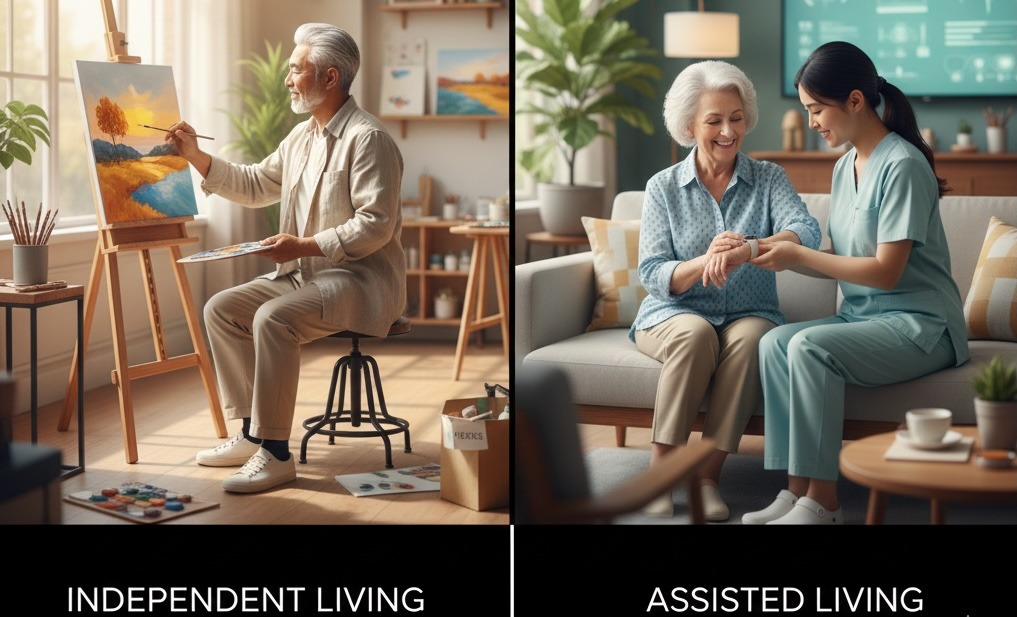
A Retirement Home (or Independent Living) is like a luxury apartment in a cool neighborhood—you have your own keys, you can choose to cook your own pasta or eat at a community cafe, and you hang out with neighbors at the rooftop bar and there are activities centred around you.
Assisted Living, on the other hand, is the full-service "Concierge Plus" experience. You’ve still got the luxury suite, but there’s someone to help you zip up your dress, manage your medicines, ensure you never miss a beat (or a pill), provide 3 meals a day and there's also activities centred around you.
In Asia, where family structures are changing faster than a TikTok trend, understanding this "Care Gap" is the key to a stress-free future.
The "ADL" Litmus Test
The professional world uses a fancy acronym: ADLs (Activities of Daily Living). This is the ultimate decider.
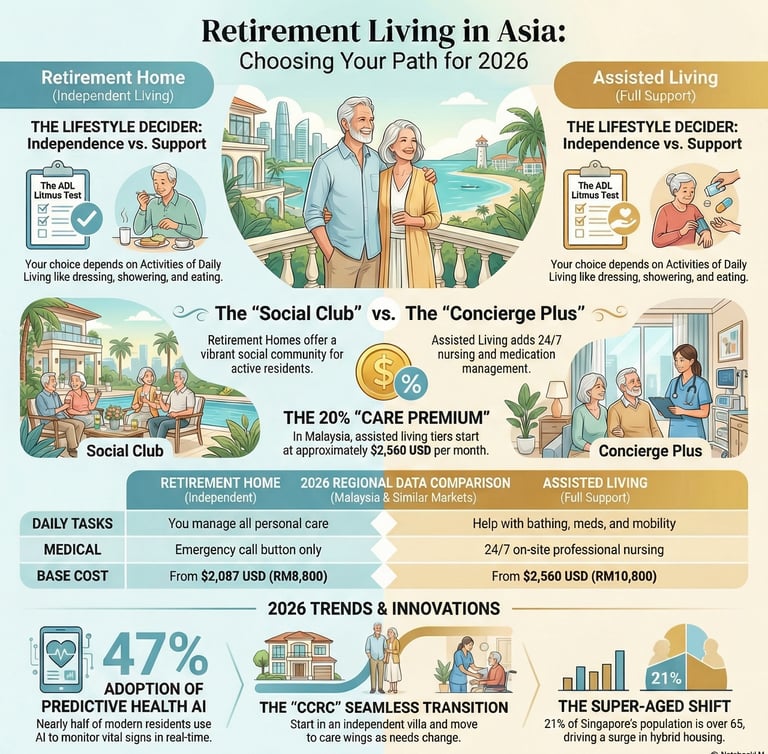
Retirement Home: You handle your own ADLs (showering, dressing, eating, toileting and movement). You're just tired of mowing the lawn or living alone.
Assisted Living: You need a "helping hand" with at least one or two ADLs. You’re active, but you’d prefer not to wrestle with a pill-organizer or a slippery shower floor by yourself.
I remember talking to a woman in Penang (槟城) last month. She moved from a traditional landed property to an assisted living resort. "I didn't move because I was sick," she told me. "I moved because I was tired of deciding what's for dinner and wondering if I'd tripped, who would hear me. Now, I have a 'care-buddy' and a social calendar busier than a teenager's!"
By the Numbers: The 2026 Landscape
The shift toward assisted living is exploding across the region. Here’s why the data matters:
The "Super-Aged" Shift: According to Singapore’s 2026 Demographic Report, 21% of the population is now over 65. This has led to a 15% surge in demand for "Hybrid" models that combine both housing and care.
The Cost Gap: In Malaysia, data from The Business Times (Dec 2025) shows that luxury independent units start around RM8,800 ($2,087 USD), while assisted-living tiers begin at RM10,800 ($2,560 USD)—a "Care Premium" of about 20%.2
Tech Adoption: A 2024 global report by SkyQuest highlights that over 47% of residents in these facilities now use predictive health AI to monitor vital signs in real-time.
Quick Comparison: Which One Are You?
Retirement Home (Independent) vs Assisted Living
1. Retirement Home (Independent Living)
The Philosophy: Freedom with a Safety Net. Think of this as "lifestyle-led" housing. You are essentially buying or renting into a country-club-style environment where the primary goal is to shed the burdens of traditional homeownership (like mowing lawns or fixing roofs) while gaining a built-in social circle.
Privacy & Autonomy: You maintain a traditional lifestyle. You cook your own meals, drive your own car, and come and go as you please.
Medical Support: It is minimal. The "emergency button" is for sudden accidents (like a fall), not for chronic care. If you develop a condition requiring daily medication management, you would likely need to hire private help or transition to a different facility.
The Social "Why": This is designed to combat the "loneliness epidemic" in aging. It’s for the couple who wants to play pickleball, join a book club, or travel for three months and know their home is secure.
2. Assisted Living (ALF)
The Philosophy: Dignity through Support. Assisted living is "needs-led" housing. It bridges the gap between independent living and a nursing home. It is designed for those who are still cognitively and socially active but find that "Activities of Daily Living" (ADLs) have become a struggle.
Privacy: While you still have your own apartment, staff will enter regularly for wellness checks or to help with tasks. It is a more "managed" way of life.
Professional Care: The 24/7 nursing presence is a game-changer for families. They manage complex medication schedules and provide physical assistance that prevents the exhaustion and "caregiver burnout" often felt by spouses.
Structured Wellness: Because residents may have mobility or cognitive challenges, social life is brought to them. Activities are often therapeutic, designed to maintain physical strength and mental sharpness. And meals are catered daily based on nutritious portions and cooking styles.
Which one are you?
Choose a Retirement Home if: You and your partner are still "Go-Go" retirees. You want to simplify your life to spend more time on travel and fitness, and you value having a community of peers. See how some seniors are crashing it with active retirement.
Choose Assisted Living if: You or your spouse are finding daily tasks (like buttoning shirts or managing 5+ pills) frustrating or risky. It is the choice for those who want to remain active but need a "co-pilot" for their physical health.
The 2026 Trend: The "Continuing Care" Community (CCRC)
Why choose one? The hottest trend in South Korea (대한민국) and Thailand (ประเทศไทย) is the CCRC. These are massive campuses where you start in an independent villa and simply "move across the park" to the assisted living wing if your needs change. No second move, no new friends to make—just a seamless transition.
1. South Korea (대한민국)
The Pioneer: Samsung Noble County (Yongin/Seoul Area)
Run by the Samsung Life Public Welfare Foundation, this is arguably the most prestigious CCRC in Korea. It is less of a "home" and more of a "tech-forward village."
The Setup: A massive 55-acre campus featuring two 20-story residential towers for independent living and a separate high-care nursing wing.
The "2026" Edge: * Medical Integration: It is directly affiliated with the world-class Samsung Medical Center, providing on-site clinics and 24-hour emergency response teams.
Intergenerational Living: Unlike many "senior islands," it houses a public sports center and a nursery school on-site, ensuring residents stay socially integrated with younger generations.
The Luxury: It features a 10-lane swimming pool, an indoor golf range, and cultural programs curated by the Leeum Museum of Art.
2. Thailand (ประเทศไทย)
The Eco-Luxury Standard: The Aspen Tree at The Forestias (Bangkok)
This is a brand-new, multi-generational forest community that integrates high-end living with lifetime care.
The Setup: Designed specifically for "Aging-in-Place." You purchase a lifetime lease that includes not just the home, but a lifetime of wellness and care services.
The "2026" Edge:
Holistic Health & Brain Center: They specialize in proactive geriatric care and dementia prevention, with 24/7 medical support integrated into the "Wellness Clubhouse."
Wellness Standards: It is the first project in Thailand built to the WELL Building Standard, focusing on air quality, lighting, and water purity to naturally extend healthspan.
The Environment: Set within a 30-acre forest, it’s perfect for active retirees who want to "Run" and "Travel" while having a serene, car-free home base. You can even train to join a Senior running event here!
The "New Residential" Choice: Jin Wellbeing County (Pathum Thani)
Located just north of Bangkok, this project focuses on "Universal Design" and medical expertise.
The Setup: A low-rise "Wellness City" where condos are connected to the Thonburi Burana Hospital—a specialist elderly care facility.
The "2026" Edge:
The "Polder" Ecosystem: The campus features 40% green space with therapeutic gardens, reflexology paths, and a "Bioswale" water system that keeps the air cool and fresh.
Smart Safety: Residents wear smart wristbands that monitor vitals and location, allowing medical teams to respond instantly to the exact spot in the park if an incident occurs.
The Bottom Line
If you’re just looking for a social club with a nice view, a retirement home is your winner. But if you want the peace of mind that comes with a professional "Safety Net," assisted living is the way to go.
Which sounds like the right fit for your lifestyle?
Disclaimer: This article is for informational purposes only and does not constitute professional medical or financial advice.

Address
Blk 8 Cantonment Close
SIngapore