Check requirements for Asia's Retirement Visas
🏃♂️ The Silver Streak: Preparing for Your Ultimate Senior Run (Diet & Training Plan)
They say "youth is wasted on the young," but anyone standing at the starting line of a 5km or 10Km event in their 60s knows that endurance is earned by the experienced.
Let’s be real: in your 20s, "training" meant making sure you had enough battery on your Discman. In 2026, training means managing heart rate variability, protein synthesis, and making sure your knees don't sound like a bowl of Rice Krispies when you stand up.
I remember chatting with a runner named Akihiro in Tokyo’s Shinjuku Gyoen National Garden. At 68, he was gracefully gliding through his morning 5K (or what the Japanese call 走り - Hashiri). I asked him his secret. He didn't mention fancy shoes or expensive supplements. He tapped his temple and said, "Nanakorobi Yaoki" (七転び八起き) — Fall seven times, stand up eight. That, and a very specific affinity for grilled salmon.
Whether you are in the "Power Phase" (45-55) or the "Resilience Phase" (55-65), here is how to engineer your body for peak performance. Check out how old is the oldest marathoner of recent times!
1. The Master’s Training Philosophy: 80/20 & Polarized Effort
As we age, our cardiovascular engine remains powerful, but our "chassis" (tendons and ligaments) becomes less forgiving. The most significant mistake Master's runners make is training at a "medium-hard" intensity every day.
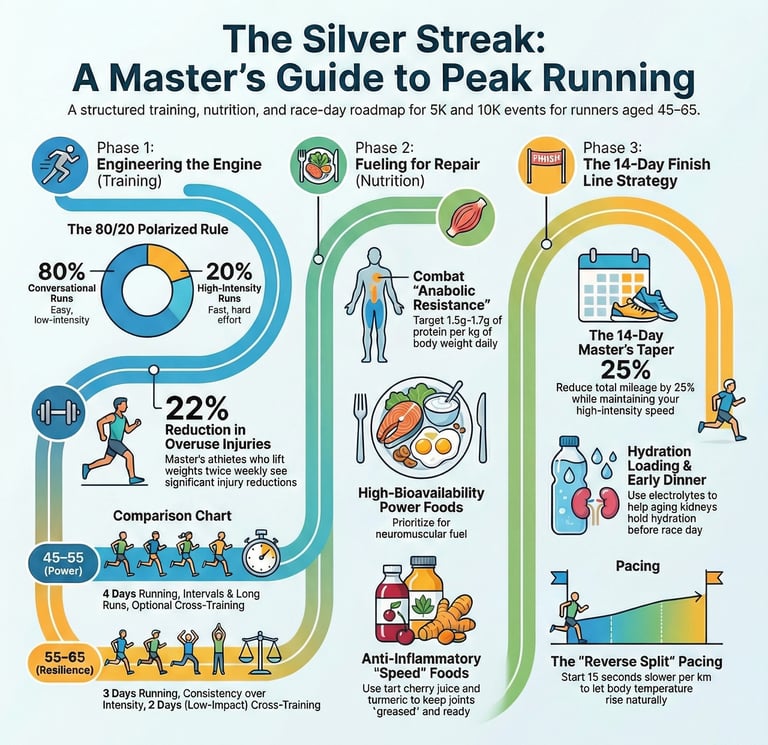
In 2026, the gold standard is Polarized Training: 80% of your runs should be at a "conversational" pace (you can speak in full sentences), and 20% should be high-intensity. According to a 2025 Sports Medicine Review, Master's athletes who integrated strength training twice a week saw a 22% reduction in overuse injuries compared to those who only ran.
The Weekly Schedule
Ages 45-55: Focus on 4 days of running. You can handle one "Speed Day" (intervals) and one "Long Run."
Ages 55-65: Shift to 3 days of running and 2 days of low-impact cross-training (swimming or cycling). Your focus is on consistency over intensity.
2. Fueling the Engine: The "High-Bioavailability" Diet
For the senior runner, food is not just calories; it is the raw material for cellular repair. After 50, our bodies deal with "Anabolic Resistance," meaning we need more protein to achieve the same muscle-building signals as a 20-year-old.
The Protein Power List (Name These Foods!)
To hit the recommended 1.5g to 1.7g of protein per kg of body weight (according to a 2024 Harvard Health study), prioritize these specific foods:
Wild-Caught Salmon: Rich in Omega-3s to fight joint inflammation.
Plain Greek Yogurt: A leucine-heavy powerhouse for muscle repair.
Tempeh or Edamame: High-density plant protein that is easy on the digestive tract.
Whey Isolate or Collagen Peptides: Use these within 30 minutes of a run to "switch off" muscle breakdown.
Eggs: The ultimate neuromuscular fuel.
Anti-Inflammatory "Speed" Foods
Tart Cherry Juice: Drink this daily for 5 days leading up to your race. It’s nature’s ibuprofen.
Turmeric & Ginger: Add these to your morning tea or smoothies to keep your joints "greased" and ready.
Sweet Potatoes: Your "slow-release" fuel. Avoid the sugar spikes of white bread; the complex carbs here provide a steady stream of energy for the วิ่ง (Wing - Thai for Run).
Check out Nutritious meal planning as you age
3. Strategy: Getting "Race-Day Ready"
You’ve done the work; now don’t ruin it in the final 48 hours. The "Silver Streak" requires a strategic approach to the finish line.
The 14-Day Taper
According to a 2024 Ageing Asia Silver Economy Report, the longevity market is prioritizing "Active Recovery" tools—use them! Foam roll, soak in magnesium (Epsom salts), and sleep 8 hours.
The 45–65 year old runner cannot "wing it." Success is won in the 14 days leading up to the starting gun.
The 25% Reduction Rule: Two weeks out, reduce your total weekly mileage by 25%, but keep your intensity (speed) the same. This keeps the legs "snappy" while allowing tendons to heal.
The Sleep Bank: You cannot "catch up" on sleep the night before a race. Start going to bed 30 minutes earlier every night for the full week prior.
The "Dress Rehearsal": 10 days out, go for a short run in the exact shoes, socks, and clothes you plan to wear. In 2026, we avoid "New Shoe Syndrome" at all costs.
The 24-Hour Countdown
Hydration Loading: Don't just drink water; drink electrolytes (Sodium, Potassium, Magnesium). Aging kidneys flush water faster; electrolytes help you "hold" that hydration.
The "Early Dinner": Eat your last big meal by 6:00 PM. Give your digestive system a full 12 hours to rest before the race starts.
5 Minutes of Brisk Walking: Get the blood flowing to the extremities.
5 Minutes of Dynamic Stretching: Leg swings, gate openers, and arm circles. (Avoid static stretching! It actually weakens the muscle before a run).
5 Minutes of Strides: Three or four 20-meter "sprints" at 80% effort to wake up your nervous system.
Pacing: The "Reverse Split"
The most successful senior runners start the first 2km of a 5K or 10K about 15 seconds per km slower than their goal pace. Let your body temperature rise naturally before you "drop the hammer" in the final kilometer.
Check out Asia's running events for Seniors.
CTA: Are you ready to claim your finisher's medal? Leave a comment below with your target race city, or check out our Master's Training Gear guide!
Disclaimer: This article is for informational purposes only and does not constitute professional medical or athletic advice. Always consult a physician before beginning a new high-intensity training program.

Address
Blk 8 Cantonment Close
SIngapore