Check requirements for Asia's Retirement Visas
What Can We Learn from the World's Oldest Marathon Finishers?
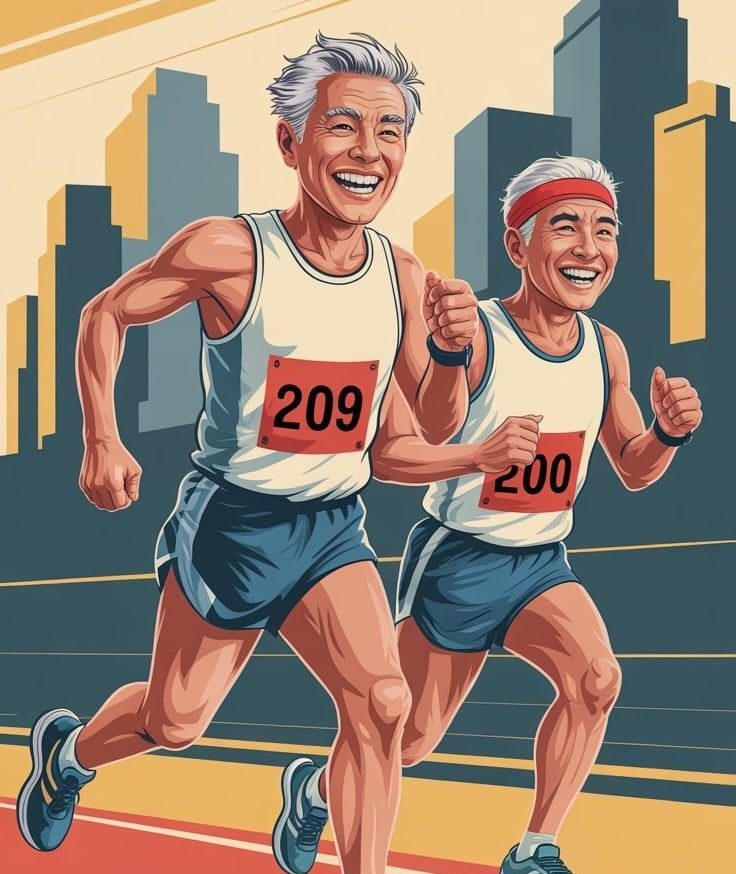
If you’ve ever been at mile 20 of a race and found yourself being effortlessly overtaken by someone with white hair and a smile that says, "I could do this all day," you’ve witnessed the "Silver Streak." In the running world, there is a legendary phenomenon called "Old Person Strength," and it isn’t just a myth—it’s a masterclass in biological engineering.
I once found myself huffing and puffing through a humidity-soaked 10K in Singapore’s East Coast Park. I was struggling, but then I saw "Uncle Tan." At 72, he wasn't just jogging; he was floating. He gave me a quick "加油!" (Jiāyóu - Keep it up!) and glided past. It was a humbling reminder that while youth has the spark, age has the flame.
What can we learn from the people who treat 42.2 kilometers like a brisk walk in the park? Let’s meet the legends and decode their "forever engines."
The Legends of the Long Game
To understand how they do it, we have to look at the people who redefined the finish line. These aren't just runners; they are "Time Travelers" who decided that aging was optional.
Fauja Singh (The Turbaned Tornado): Perhaps the most famous senior runner in history, this British-Sikh centenarian didn't even start running until he was 81. He became the first 100-year-old to complete a marathon in 2011. His secret? A "stress-free" mind and a diet of ginger curry and tea.
Ed Whitlock (The Master of the Sub-3): A Canadian legend who shocked the world by running a 2:59:10 marathon at age 73. To put that in perspective, most 25-year-olds can't break four hours. He famously trained by running in circles around a local cemetery for hours at a time.
Gene Dykes (The "Ultra" Senior): In his 70s, Gene continues to shatter records, often running "sub-3" marathons and 100-mile ultra-marathons. He attributes his success to "running hard" even in his 70s, defying the idea that seniors must always go slow.
Mieko Okamoto (The Japanese Icon): In a country that celebrates 長寿 (Chōju - Longevity), Mieko has set numerous age-group records. Japan has the highest concentration of senior marathoners, and runners like Mieko prove that consistent, low-intensity movement is the key to a 90-year-old heart that functions like a 40-year-old’s.
You may get to meet some of these senior runners at a running event in Asia
How They Do It: The "Silver" Blueprint
According to a 2024 report from the International Journal of Environmental Research and Public Health, the number of marathon finishers aged 70 and older has increased by 21% over the last decade. Here is the science behind the stamina.
1. Neuromuscular Efficiency (The "Quiet" Engine)
While younger runners rely on raw explosive power, senior marathoners rely on efficiency. Their brains and muscles have spent decades "learning" the most economical way to move. They waste zero energy.
The Lesson: Focus on form and "smoothness" rather than just speed.
2. Tendons Like Steel Cables
We often worry about muscle loss (Sarcopenia), but for senior runners, tendon health is the real MVP. A 2025 study from the Mayo Clinic revealed that lifelong endurance runners over 75 have a "biological muscle age" that is nearly 30 years younger than their sedentary peers.
The Lesson: Consistent, low-impact loading (like daily walking or slow jogging) keeps connective tissue resilient.
3. The 80/20 Rule: The "Low and Slow" Secret
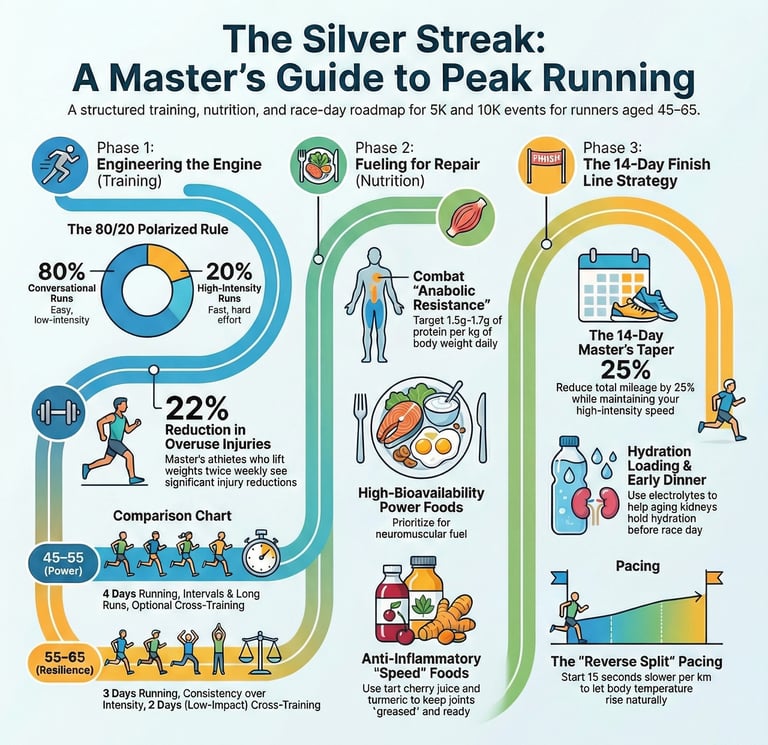
Most of the world’s oldest finishers spend 80% of their training in Zone 2—a pace where you can easily hold a conversation.
The Lesson: Don't turn every run into a race. The "slow" miles build the aerobic base that supports the "long" miles.
Preparing for the Long Haul
If you’re looking to join the ranks of the ageless, follow this simple 3-step process:
Prioritize Protein & Collagen: As we age, we need more protein to repair muscle. Focus on Salmon, Greek Yogurt, and Eggs.
Isometric Strength: Incorporate "holds"—like calf raises or planks—to keep joints stable without high-impact stress.
Mental Resilience: Learn from Fauja Singh. He viewed the marathon as a "celebration of life," not a task to be endured.
According to 2026 projected health data, seniors who participate in regular endurance events show a 40% lower risk of cognitive decline. For these legends, the marathon isn't just about a medal; it’s a neuroprotective shield.
FInd out about training and eating regime that these seniors could be adopting.
3. The "Silent" Cognitive Advantage
Running a marathon is 10% physical and 90% mental—but when you’ve lived through eight decades of life's ups and downs, your "mental" game is on another level. Senior runners possess a psychological resilience that younger runners often lack. They know how to suffer comfortably.
According to a 2024 report from the Global Council on Brain Health, older adults who engage in high-level aerobic activity like marathon training show significantly higher levels of BDNF (Brain-Derived Neurotrophic Factor), which helps repair brain cells. For them, the marathon isn't just a race; it’s a neuroprotective strategy.
4. Practical Lessons for the Rest of Us
You don't have to be 90 to start training like a legend. Here are the core pillars we can steal from the world’s oldest finishers:
Patience is a Performance Enhancer: Most senior finishers didn't start running until their 40s or 50s. It is never too late to build an aerobic base.
The 80/20 Rule: They spend 80% of their time in Zone 2 (easy, conversational pace). This prevents the chronic inflammation that bogs down younger, "ego-driven" runners.
Fueling for Longevity: You won't find many 80-year-old marathoners living on processed "energy gels." They tend to favor real-food fueling—think sweet potatoes, bananas, and high-quality proteins like salmon.
You may get to meet some of these senior runners at a running event in Asia.
CTA: Who is your running hero? Share this article and tag a "Silver Streak" runner who inspires you!
Disclaimer: This article is for informational purposes only and does not constitute professional medical or athletic advice. Always consult a physician before beginning a new high-intensity training program.


Address
Blk 8 Cantonment Close
SIngapore