Visa rules change all the time. Stay legal by checking requirements for Asia's Travel and Retirement Visas. Updated July 2026.
No House, No Problem: 5 Asian Countries Where You Can Retire on a Lease
Can you retire in Asia without buying a home? Yes! Explore 2026's top 'rent-friendly' visas in Thailand, Philippines, Cambodia, and more. Keep your cash liquid.
GEO-ARBITRATE RETIREMENT
2/11/20264 min read


Mabuhay! Sawatdee! (สวัสดี) and Xin chào! If your dream retirement involves waking up to a view of the Andaman Sea or the rice terraces of Bali, you’ve probably heard the old advice: "You have to buy property to get the visa."
In the "old world" (pre-2025), that was often true. But as we navigate 2026, the game has changed. With new tiered visa systems and a global shift toward liquidity, the smartest retirees aren't tying their life savings into a condo they might want to leave in three years. They are renting.
If you too have decided to rent rather than buy a property for your retirement in Asia, that's actually not a bad decision. Think about it, while chasing your dream of a tropical paradise, what if things does not work out? Think political unrest (it does happen from time to time), the need to return home (think family commitment), a health issue that require you to seek medical attention elsewhere or just that you have run out of joy at your host nation and could do with a change. Why Geo-arbitrate retirement still remain a good idea.
Is it than possible to secure a long-term residency without a title deed in your retirement country? Absolutely. Here are the top five Asian countries where you can retire on a lease without the "property trap." Then you can lead your active retirement in peace rather than worry about property values or maintenance all the time.
1. Thailand: The Gold Standard for Renters
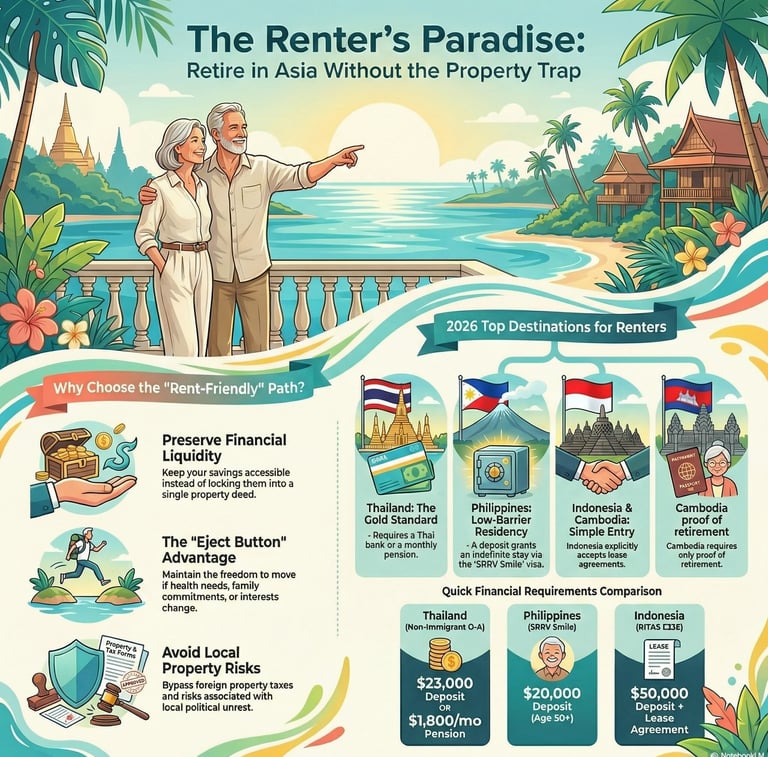
Thailand remains the most "renter-friendly" retirement destination in 2026. The Non-Immigrant O-A (Long Stay) visa is the primary path for those over 50.
The 2026 Rule: You only need to show 800,000 THB (approx.2 $23,000 USD) in a Thai bank account or a monthly pension of 65,000 THB.
The Rental Factor: You are not required to buy a single brick. In fact, most retirees find that renting a luxury condo in Chiang Mai for $600 a month gives them more freedom than owning one ever could.
2. The Philippines: Low Barrier, High Value
The Special Resident Retiree’s Visa (SRRV) in the Philippines is legendary for its flexibility. While you can use your deposit to buy a condo, you don't have to.
The 2026 Rule: For retirees aged 50+, a simple $20,000 USD deposit (or $10,000 if you have a pension of $800/month) grants you an indefinite stay.
The Rental Factor: The "SRRV Smile" category is specifically designed for healthy retirees who want to keep their deposit liquid in a bank while they rent a beachfront villa in Siargao or a condo in Makati.
3. Cambodia: The "Ease of Entry" King
Cambodia’s ER (Retirement) Visa is perhaps the most straightforward in Southeast Asia.
The 2026 Rule: There is no massive "security deposit" like in Thailand or Indonesia. You simply need to show proof of retirement (pension or savings) and pay a modest annual fee.
The Rental Factor: Cambodia is a "pure" renter's market for retirees. With zero property purchase mandates, you can sign a lease in Phnom Penh or Siem Reap and extend your visa year after year with minimal bureaucracy.
4. Indonesia: The Island Life (KITAS E33E)
Bali remains the dream, and in 2026, the Retirement KITAS (Index E33E) is the path for those who want the island lifestyle without the $1 million "Second Home" price tag.
The 2026 Rule: Available to those 60+, it requires a $50,000 USD deposit and a monthly income of $3,000.
The Rental Factor: This visa explicitly asks for a lease agreement. Indonesia wants you to show where you are living, but they don't demand you own it. It’s the perfect setup for someone wanting a 5-year stay in a Balinese villa.
5. Vietnam: The Digital/Investor Hybrid
While Vietnam still lacks a formal "retirement visa," it has become a haven for those using the DT4 Investor Visa or the newly expanded 90-day E-visa.
The 2026 Rule: Retirees often use the DT4 path by "investing" a small amount (under $115,000 USD) in a local entity, which grants a 1-year renewable residency.
The Rental Factor: Because land ownership for foreigners is strictly leasehold (the "Pink Book" system), almost everyone in Vietnam—even those with "ownership" rights—is effectively a long-term renter.
📉 2026 Visa Comparison: No-Purchase Pathways
Thailand Non-Immigrant Visa. O-A~$23,000
Philippines SRRV Smile Visa $20,00050
Cambodia ER Extension Visa Low (Fees only)
Indonesia KITAS E33E Visa $50,000-$60,000
Vietnam DT4 (Investor) Visa <$115,000
⚠️ The "Malaysia Warning" (2026 Update)
You might notice Malaysia is missing. In 2025/2026, the federal MM2H program shifted to a tiered system that now mandates a property purchase (starting at RM 600,000).
Pro Tip: If you want Malaysia without buying, look into the Sarawak MM2H (S-MM2H). It still operates under separate, more flexible rules that allow for fixed deposits without the house-buying requirement! The great thing about procuring Sarawak MM2H is that it allows you residence in both East and West Malaysia with the same ease and convenience if you had procure your MM2H from say KL or Penang.
The Verdict: Why Rent?
In 2026, the flexibility to leave is just as valuable as the permission to stay. By choosing a "rent-friendly" visa, you protect your capital, avoid local property taxes, and keep the "eject button" ready if you decide the tropical humidity isn't for you after all. Why rent rather than buy has become the new mantra for retirees to Asia.
Are you worried about the paperwork? Would you like me to create a step-by-step checklist for the Thailand O-A or the Philippines SRRV application process?
Disclaimer
Disclaimer: Visa laws in Southeast Asia are subject to sudden change. This information is current as of January 2026. Always verify with the respective embassy or a professional visa agent before making travel plans.

Address
Blk 8 Cantonment Close
SIngapore