Visa rules change all the time. Stay legal by checking requirements for Asia's Travel and Retirement Visas. Updated July 2026.
Why is Renting Becoming the Top Choice for Retirees in Asia in 2026?
Discover why 2026 retirees are ditching property ownership for 99-year leases and rental mobility in Asia. Explore liquidity, visa agility, and new laws.
RETIREMENT PLANNINGGEO-ARBITRATE RETIREMENT
2/10/20264 min read

Sawatdee khrap (สวัสดีครับ) and Apa kabar!
If you had asked a retiree in 2016 where they wanted to live in Asia, the answer was almost always, "I want to buy a little piece of paradise." We all had that vision: a white-stucco villa in Phuket or a high-rise in Kuala Lumpur with a view that made your high school friends jealous. But fast-forward to 2026, and the "property trap" has lost its luster. From the beaches of Cebu to the mountains of Da Lat, a new wave of retirees is trading in their title deeds for the ultimate luxury: mobility.
Take the case of my friend "Jungle Jim." In 2019, he sank his entire nest egg into a gorgeous teak-wood house in Chiangmai, Northern Thailand. He loved it—until a new highway was built 50 yards from his bedroom in 2024. He’s spent the last two years trying to sell it in a "saturated" market, while his knees are telling him he should have moved to a condo with an elevator months ago. Jim didn't own the house; the house owned Jim. In 2026, Jim is the cautionary tale, and "Rental Royalty" is the new goal.
1. The Liquidity Revolution: "Cash is King"
In 2026, retirees are more financially savvy than ever. According to the Manulife Asia Care Survey 2025, only 35% of respondents now consider property a key tool for retirement preparation—a massive drop from 65% just a few years ago.1
The reason? Liquidity. Retiring in a foreign land involves currency fluctuations and unexpected healthcare needs. Sinking $500,000 into a Thai condo or a Malaysian villa means that capital is "locked." If the local currency dips or you need funds for an emergency, selling a foreign-owned property can take months—or years. Renting allows you to keep your nest egg in high-yield global accounts, drawing only what you need to live like a local king.
The Real-Life Math: Consider "Sarah," a 66-year-old from London. Instead of buying a $400,000 villa in Bali, she rents a luxury suite for $1,500 a month. She keeps her $400,000 in a diversified global portfolio yielding 6%.
The Result: Her portfolio generates $2,000 a month—paying her rent entirely while her principal stays untouched. If she had bought the villa, her money would be "dead capital," subject to Indonesian property tax and the whims of the local real estate market.
2. The 99-Year Lease: Ownership Without the Headache
One of the biggest game-changers for 2026 is the Philippines’ Republic Act 12252, signed in late 2025.2 This landmark legislation allows foreigners to lease private land for up to 99 years.
"For the first time, we have the security of ownership without the constitutional nightmare of 'owning' the dirt," says Arthur, a British expat living in Dumaguete. "My 99-year lease is transferable and bankable. I don't need a title deed when I have a century of guaranteed residency."
Compare this to Thailand, where the standard lease is still often 30 years. The Philippines has created a "middle path" that provides the stability retirees crave while avoiding the legal "nominee" schemes that led to so many horror stories in the past.
This shift toward long-term leasing provides the stability retirees crave while avoiding the legal "nominee" schemes that led to so many horror stories in the past.
3. Visa Agility: The "MM2H Effect"
The landscape of retirement visas in Asia is as shifty as the monsoon winds. The Malaysia My Second Home (MM2H) 2025/2026 tiers now require property purchases for certain levels (e.g., RM600,000 for the Silver Tier).3
However, many retirees are choosing to stay on more flexible visas, such as Thailand’s LTR (Long-Term Resident) or Vietnam’s 10-year Electronic Residency, which don't mandate property ownership. By renting, you remain "visa-agile." If a country changes its tax laws or residency requirements, you can simply pack your bags and move your retirement to the next welcoming neighbor without a fire sale.
Buying vs. Renting in 2026: At a Glance
Buying (Ownership)
Capital Requirement High (Upfront)
Maintenance Your Responsibility
Exit Strategy Difficult/Slow
Legal Security Subject to Ownership Caps
Visa Flexibility Locked to one country
Renting (Leasehold)
Capital Requirement Low (Monthly)
Maintenance Landlord's Responsibility
Exit Strategy 30-day Notice
Legal Security Protected by Lease Contracts
Visa Flexibility High Mobility
4. The Maintenance-Free Lifestyle
Asia is beautiful, but its climate—humid, salty, and tropical—is brutal on buildings. Termites, tropical storms, and air-con mold are full-time jobs.
In 2026, the modern retiree values time over equity. When the roof leaks in a rental in Bali, it’s the landlord’s problem. For an owner, it's a three-week hunt for a reliable contractor in a language you might not fully speak yet. Renting in a serviced "lifestyle community" or a modern condo complex means you spend your days on the golf course or the beach, not at the hardware store. Having liquid cash for active retirement is more important than being tied up in a property.
The Maintenance Gap:
The Owner's Reality: You spend your retirement "managing" people. Finding a reliable plumber in a second language, dealing with "sinking fund" disputes in your condo board, and paying the "foreigner price" for roof repairs.
The Renter's Reality: You live in a Lifestyle Community. When the AC dies at 2 PM in Bali, you call the front desk. By 5 PM, you’re back to a cool 20°C, and you didn't spend a cent.
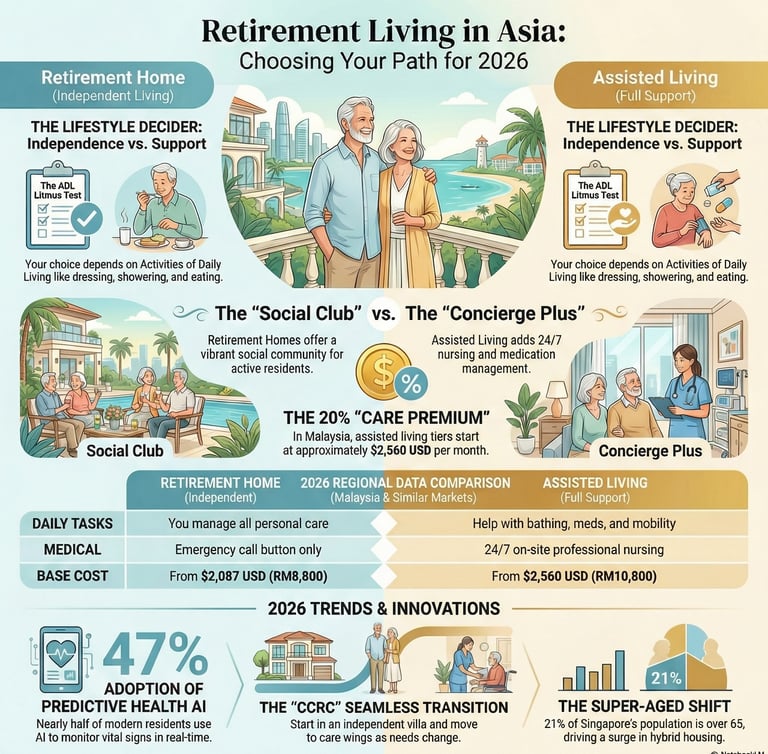
In 2026, we see a massive rise in "Serviced Retirement Hubs" in cities like Chiang Mai and George Town, where your rent includes housekeeping, gym access, and 24/7 security. Staying in a Retirement home vs Assisted Living home
The Verdict
Is it "better" to rent? In 2026, the numbers say yes. Unless you plan to stay in one exact spot for 20+ years and have the stomach for local bureaucracy, renting offers a level of freedom that ownership simply cannot match.
Remember: You are retiring to Asia to enjoy life, not to become a real estate manager.
Best activities for a solo female retiree in Asia.
Call to Action (CTA)
Are you considering a move? Would you like me to generate a personalized 'Cost of Renting vs. Owning' comparison for a specific city like Chiang Mai or Penang?
Disclaimer: This article is for informational purposes only. Real estate laws and visa requirements change frequently. Always consult with a qualified legal professional in your target country before making financial commitments.

Address
Blk 8 Cantonment Close
SIngapore