Visa rules change all the time. Stay legal by checking requirements for Asia's Travel and Retirement Visas. Updated July 2026.
The Global Spring Festival: 7 Asian Countries Where Lunar New Year is a Public Holiday
Lunar New Year is a public holiday in 7 Asian countries! Discover unique traditions like Korea’s Seollal, Vietnam’s Tết, and Malaysia’s chaotic Yee Sang Prosperity Toss.
TRAVELFESTIVALS
1/28/20263 min read
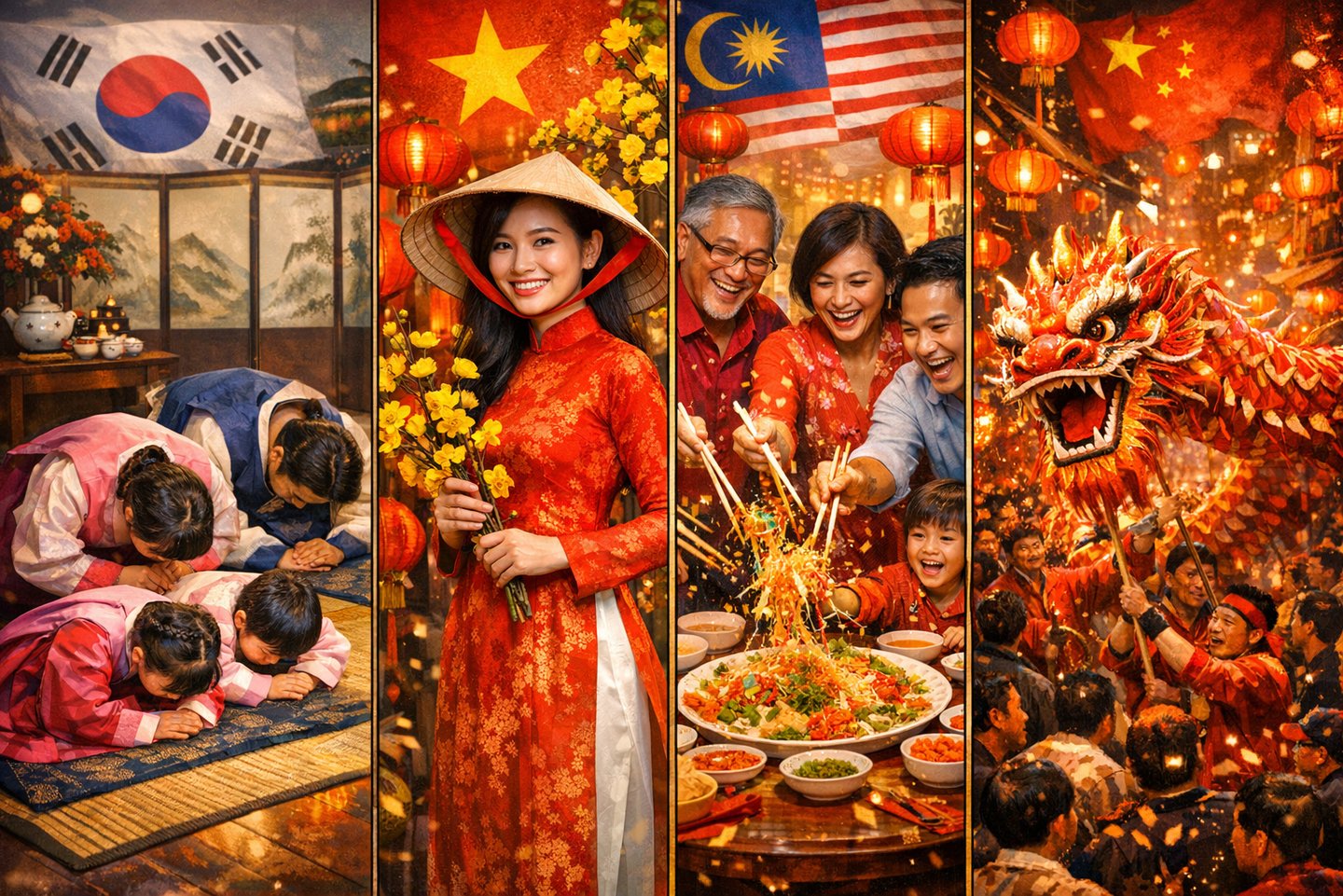
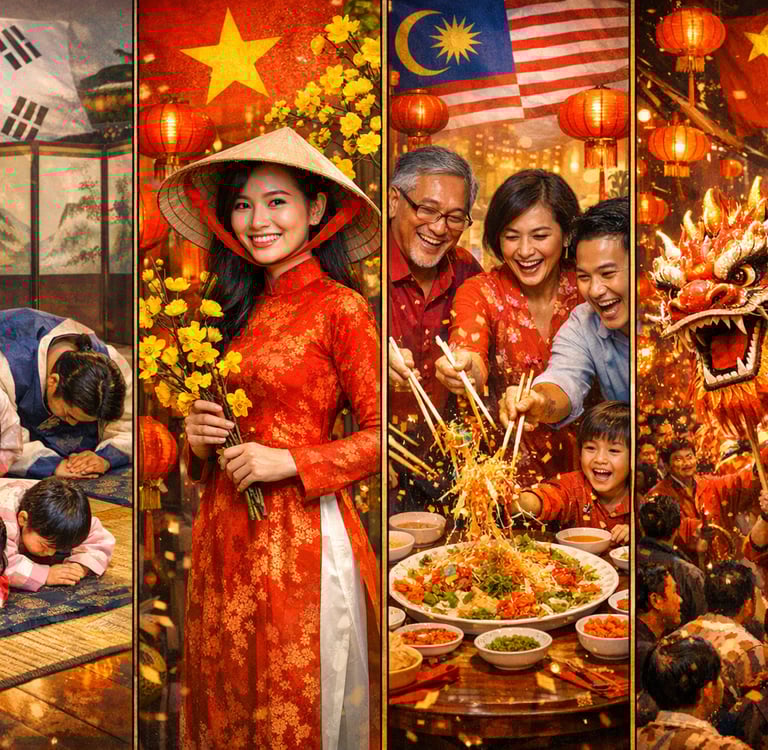
It's that time of the year again. When the Lunar New Year arrives February 17th this year, the world often pictures China—the red lanterns, the fireworks, and the biggest human migration on Earth. But the celebration, often called the Spring Festival (春節 - Chūnjié), is a foundational cultural holiday, not just in mainland China but across nearly half the globe, particularly in many parts of Asia.
It’s not just a commercial event; it’s a national pause. In many Asian countries, the day is officially recognized as a time for family reunion, remembrance, food and drinks.
Did you know that in some countries, people celebrate for up to four days or more? Roads will be jam packed as people travel home, factories may close for 7 days or more, retail and mall shops will close for 3 days or more, fast food chains may open but restaurants are likely to be closed.
Let's travel across Asia and look at 7 countries where the Lunar New Year brings public life to a celebratory halt, and see how their traditions differ.
Not forgetting the Chinatowns, decked in red and gold, across the world; from South America to Europe to Africa. It's a time of celebration, joy and family.
1. The Powerhouse Celebrations
These nations have large ethnic Chinese populations or have historically adopted the Lunar calendar, leading to multi-day breaks:
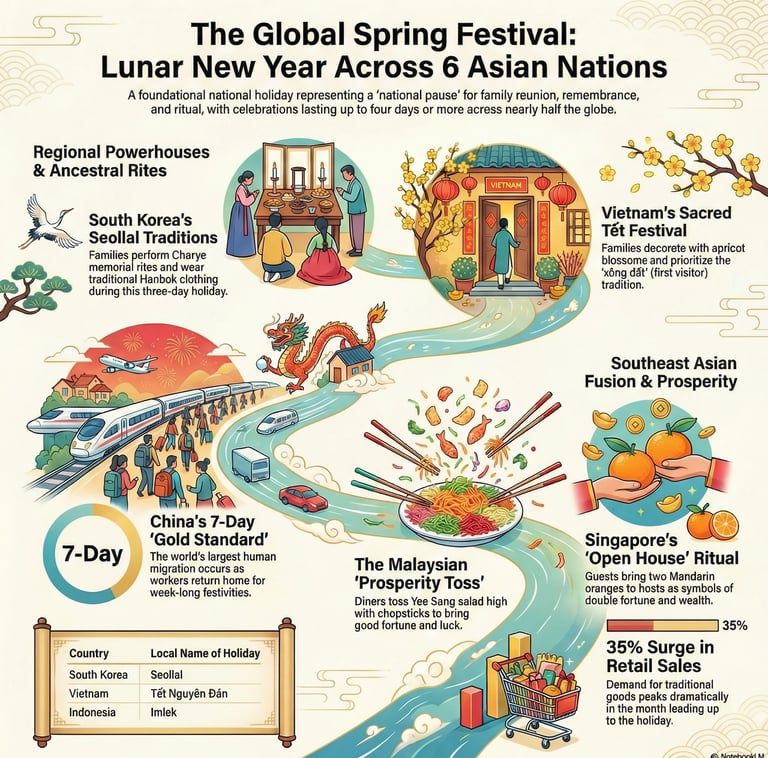
🇨🇳 China (People's Republic of China): The gold standard. The official holiday is typically seven days long (but often much longer for migrant workers). It's focused entirely on family, food, and securing good fortune.
🇰🇷 South Korea (Seollal - 설날): This is distinct from the Chinese festival but shares the lunar calendar base. Seollal is a three-day national holiday dedicated to honoring ancestors and elders. Families perform Charye (차례), a memorial rite, and wear traditional clothing called Hanbok.
🇻🇳 Vietnam (Tết Nguyên Đán): Simply known as Tết, this is Vietnam’s biggest and most sacred celebration. It is fiercely centered on family and home. Families decorate with apricot blossoms and chrysanthemums, and a key tradition is the careful selection of the first visitor (xông đất) who enters the house on New Year's Day.
2. The Fusion Festivals: Where Traditions Blend
In these Southeast Asian countries, the Chinese diaspora has influenced national culture, leading to colorful and unique local traditions:
🇸🇬 Singapore: Due to its majority ethnic Chinese population, the celebrations are massive. A unique tradition is the "Open House" ritual, where family and friends visit homes, usually bringing two Mandarin oranges (Kam - 柑) as a symbol of double fortune.
🇲🇾 Malaysia: Celebrated by the significant Chinese population, Malaysian Lunar New Year features the famous Yee Sang (魚生) or "Prosperity Toss." This is a raw fish salad where diners stand up, use long chopsticks, and toss the ingredients high into the air while shouting auspicious wishes. It's messy, loud, and fantastic.
🇮🇩 Indonesia: Known as Imlek, the celebration here saw a resurgence after being restricted for decades. Today, it is a protected cultural event, with vibrant temple visits and community celebrations, particularly in Jakarta and Medan.
🇵🇭 Philippines: Officially a non-working special public holiday for the "Chinese New Year." Manila's Binondo (the world’s oldest Chinatown) erupts in parades, dragon dances, and street markets, mixing Chinese traditions with the Filipino culture's focus on food and family gatherings.
The practice of "Open Houses" and cross-cultural feasting during the Lunar New Year in multi-ethnic nations like Singapore and Malaysia is so strong, that retail sales of traditional goods can jump by over 35% in the month before the holiday (Source: 2024 Asian Retail Trends Report, Deloitte).
Your Global Lunar New Year Checklist
Whether it’s the quiet reverence of a Korean Seollal ceremony or the chaotic joy of a Malaysian Yee Sang toss, the core message remains the same across Asia: family, renewal, and hope for prosperity.
Reunion: Be home or with family.
Cleansing: New clothes and a clean house to start fresh.
Respect: Honor elders and ancestors.
Prosperity: Exchange red envelopes (or cash gifts).
Have you experienced Lunar New Year in Seoul, Hanoi, or Kuala Lumpur? Share your favorite unique tradition from the global Spring Festival!
Other festival links:
What is the CNY Reunion dinner about?
Lunar New Year in Vietnam - Tet
Disclaimer: This article is for informational purposes only and does not constitute professional cultural or travel advice.

Address
Blk 8 Cantonment Close
SIngapore