Visa rules change all the time. Stay legal by checking requirements for Asia's Travel and Retirement Visas. Updated July 2026.
How to Celebrate Seollal Like a Local: A Guide to Korean Lunar New Year Traditions
Learn how to celebrate Seollal (설날) like a local! Master the traditions, the Sebae bow, the meaning of Tteokguk, and the Charye ancestral rites of Korean New Year.
KOREAFESTIVALS
2/1/20263 min read
🇰🇷 The Great Korean Homecoming (설날)
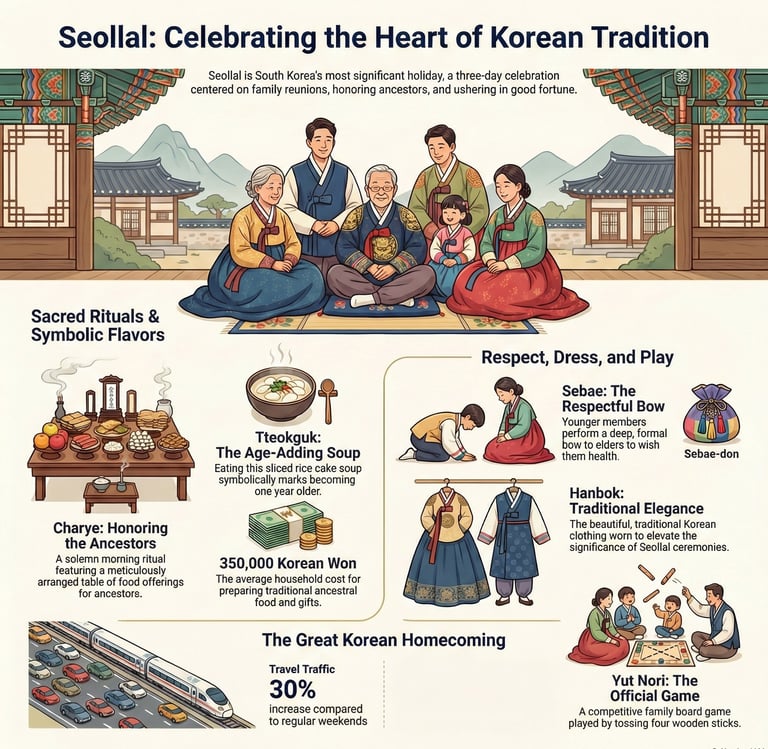
Imagine the biggest holiday of the year—Christmas, Thanksgiving, and your family reunion all rolled into three days. That is Seollal {설날}, the Korean Lunar New Year. It is arguably the most important holiday in South Korea, marking a time for family, ancestor reverence, and symbolically gaining one more year of age.
If you are ever in Korea during this time, you will witness the "Great Migration"—millions of Koreans traveling, often for hours, from large cities back to their ancestral hometowns. The highways become parking lots, and the train stations are packed. It’s an undeniable sign that for Koreans, home is where the heart is, especially during {설날}.
I once spent a Seollal in Seoul, thinking it would be exciting. Instead, the city was quiet! Everyone had left. I realized quickly that to experience the real Seollal, you have to understand the essential traditions that bind the holiday together.
Here is your local guide on how Koreans genuinely celebrate this sacred time.
🍚 The Ritual: Tteokguk and the Ancestral Table (Charye)
The foundation of Seollal is respect for one's ancestors and the ritualistic start to the new year.
1. The Ancestral Rite (Charye -차례}
On the morning of Seollal, families perform Charye, a solemn ritual to honor their ancestors. A vast, meticulously arranged table is set up with dozens of different foods, including meats, fruits, and special rice cakes. The food is symbolic—an offering to thank the ancestors and invite their blessing for the new year.
Rule of Thumb: Specific rules dictate where each food item must be placed (e.g., fruit must face the West, fish must face the East). It's a complex, beautiful ballet of tradition.
2. The Age-Adding Soup (Tteokguk - 떡국)
The moment the Charye is complete, the family gathers to eat Tteokguk, a soup made with thin, sliced white rice cakes. This is more than just a meal; it is a ritualistic act of aging.
Tradition says: You don't officially become one year older until you have consumed a bowl of Tteokguk.
🙏 The Bow: Showing Respect (Sebae)
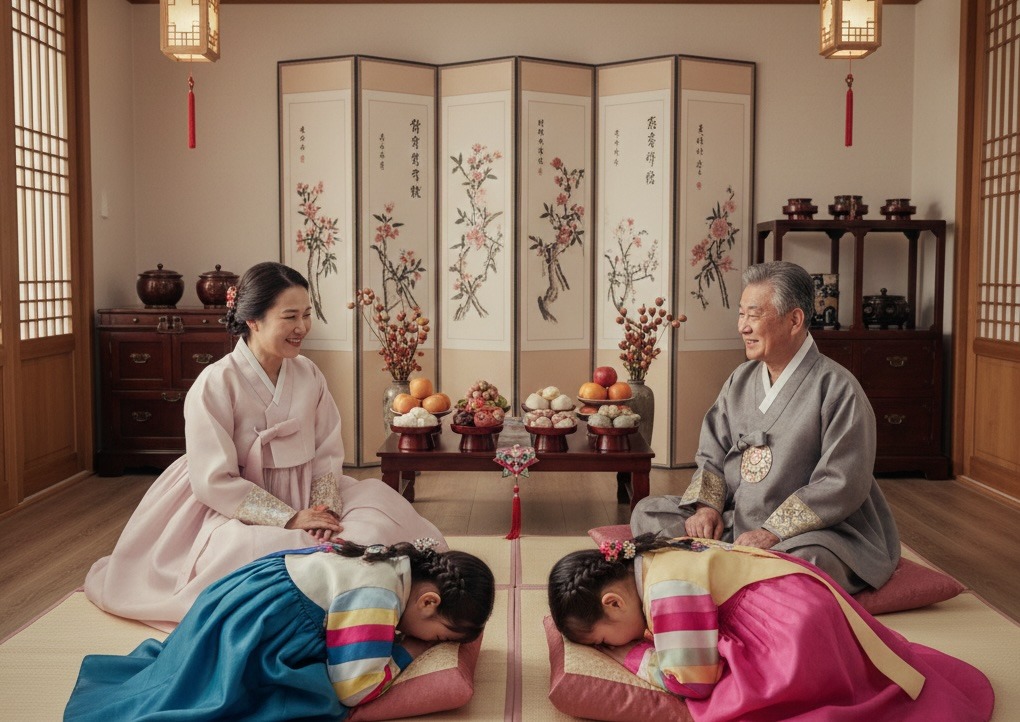
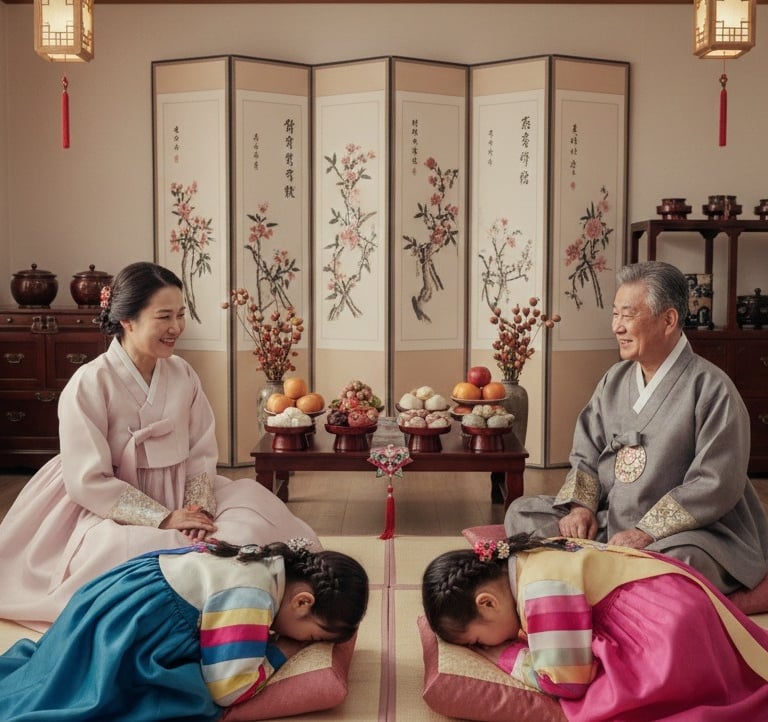
The most iconic visual of Seollal is the formal, deep bow known as Sebae ($\text{세배}$).
After the ancestral rites, the younger family members perform Sebae to the elders (parents, grandparents, aunts, and uncles). This is a profound gesture of respect and a wish for the elders' health and long life.
The Exchange: After the bow, the elders offer words of wisdom (Deokdam) and give the children Sebae-don {세뱃돈}, or "New Year's money," often in small, decorated pouches.
The Attire: To perform Sebae, many Koreans wear a Hanbok {한복), the beautiful, traditional Korean clothing. This formal attire elevates the significance of the moment.
Data Point: According to a 2024 survey conducted by the Korea Rural Economic Institute, the average cost of preparing Seollal ancestral food and gifts for a household was estimated at around 300,000 to 350,000 Korean Won (approximately $225-$260 USD), highlighting the financial investment in tradition.
🎭 The Play: Games and Fortune
The rest of the holiday is dedicated to joyful, collective activities.
Yut Nori {윷놀이}: This is the official Seollal game. It is a traditional board game involving four wooden sticks that are tossed like dice. It’s a great way for three generations to gather and enjoy some competitive fun.
Flying Kites (Yeonnalligi): Traditionally, this was done to send away bad luck from the previous year.
Fun Fact: The massive travel rush during the Seollal period typically sees passenger traffic spike by over 30% compared to a regular weekend, according to the Korean Ministry of Land, Infrastructure, and Transport. This emphasizes the national priority of family reunion.
Seollal is truly the heart and soul of Korean culture. It's a structured, respectful, and delicious way to cleanse the past, honor the lineage, and look forward to a fortunate year.
👉 Call-to-Action
What part of Seollal traditions—the food, the clothing, or the bowing—do you find most fascinating? Tell us in the comments! If you’re planning a trip to Korea, share this article with your travel companions.
Find out how Spring Festival is celebrated in different parts of Asia
Find out how the Vietnamese celebrate Lunar New Year
Find out the massive trip home for Chinese New Year Reunion Dinner
Find out how friendly South Korea is to the seniors and elderly
Disclaimer: This article is for informational purposes only and does not constitute professional advice.

Address
Blk 8 Cantonment Close
SIngapore